CUSTOMS, CAMERAS AND COMIC RELIEF (Part One)
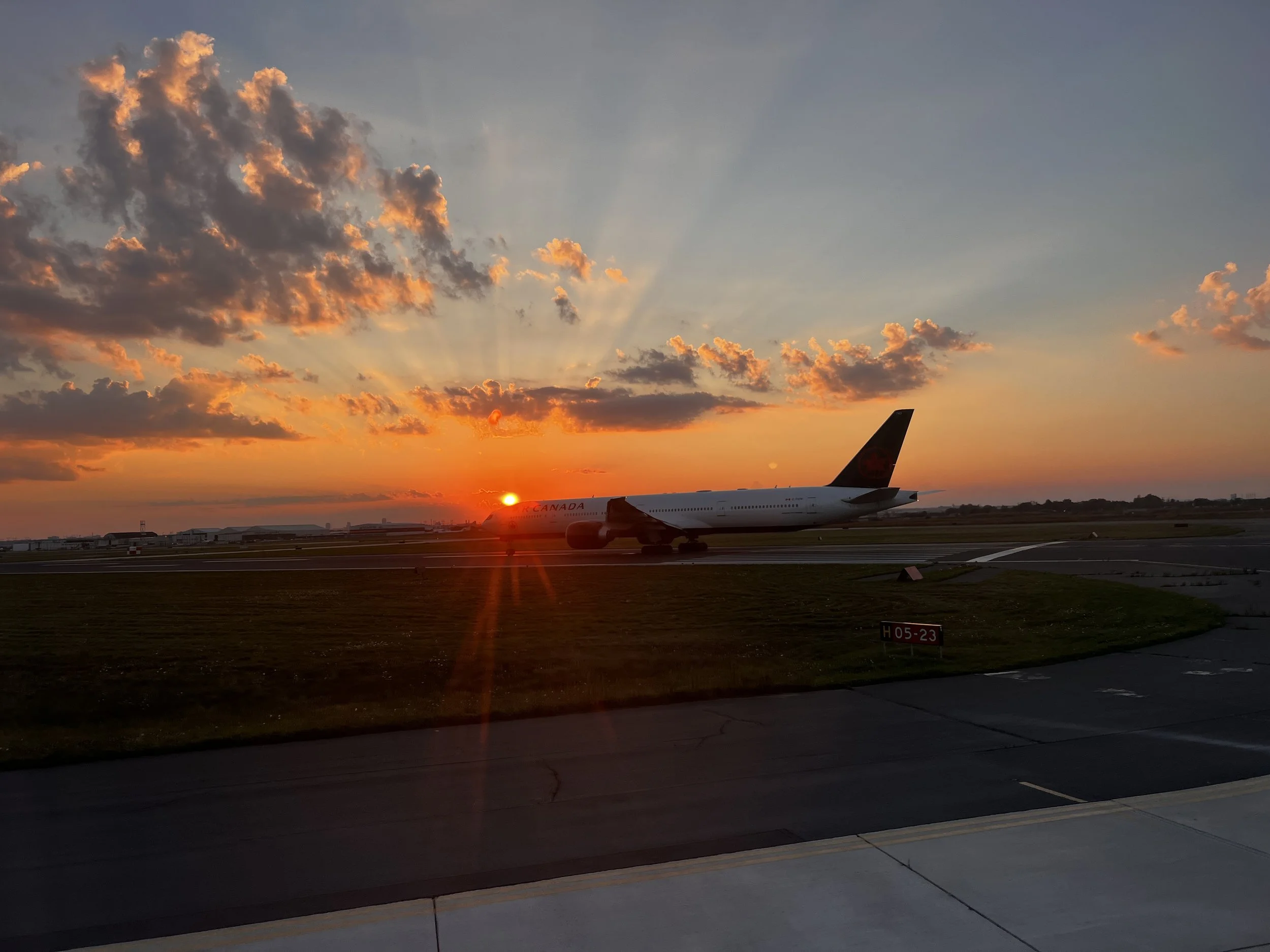
Crossing the border preboarding screening.
This series of encounters is about the joy of crossing the border when you travel with me. It is part of my monthly submission to the BWL Publishers writer’s short story blog.
I have been told on many occasions that I have enough border-crossing stories to fill a book. I’m not sure there are enough to fill a book, but there are enough for this short story.
Let us start by providing you with the background information you need to get the full picture. This will explain most of my border-crossing adventures. My basic premise is that I can’t tell a serious lie without it showing on my face. If I do, I will be caught, not maybe, but WILL BE CAUGHT. In all fairness, I kid, joke, and tell small lies for fun – but they are nowhere near a border crossing.
Another material fact you need to know is that my Canadian passport lists my birthplace as Cairo, Egypt, and that I have a brown complexion. I also have a NEXUS card and don’t want to lose it.
Forty years ago, I had thick black hair and a matching, well-trimmed beard.
This is not making fun of the people doing their jobs or complaining about them in any way, shape, or form. They are doing a very serious job and protecting their country, whether it is Canada or the US. Still, border crossings make me nervous for no reason. These are just stories about specific encounters, not complaints.
Finally, I always carry very expensive camera equipment, and sometimes I have even bought some in the US for convenience (more on those later).
Come along and join me on these stories of crossing the border. Each trip will have a name, location and type of crossing.
The film canisters and lens case
The Film Cannister Caper – Pearson Airport
At the time, I was in my early thirties, with slightly longer, very curly, jet-black hair and a thick but well-trimmed black beard. In retrospect, if this were my job to check a person more closely, I would fit the racial profile of someone you would need to vet more thoroughly before letting them on an airplane with three hundred people. Add a bit of my nervous Nellie, Donna, who was with me and is a very nervous flyer. BUT that is just the start.
Those were the film days, when film cartridges were packed in a plastic canister with a rubbery lid that one pried open to get the film. Typically, as a prodigious shooter, I carried two 36-exposure rolls per day. I used Kodachrome for slides and Kodak Professional colour film for prints. On a two-week holiday, that meant twenty-five to thirty rolls of film. I never knew whether they wanted the film out of the boxes or even out of the canisters. Generally, the rolls were only out of the boxes, and I carried them in a plastic bag, inside the canisters.
I could never leave the film out of my sight for fear of losing it. As a result, I had to have the film checked by security, which annoyed them. There was a time when photographers worried about X-ray machines, but I resisted at first and never made an issue of it because I would be tense enough just going through the process.
I came up with a brilliant idea to carry as much film as possible. My favourite telephoto lens came with a tube case that I could thread my belt through and wear on my hip. It was a black tube, four inches in diameter and fourteen inches long. The tube had a zippered opening, a carrying strap, and a belt loop. If that didn’t look suspicious enough, I used black electrical tape to join two canisters end-to-end at the sealed plastic end. I figured I could use the black strap to turn this into an extraordinary lens and film carrier. I taped two canisters to each side of the strap.
I had never considered how suspicious I might have looked to someone about to let me onto an airplane with three hundred people. Now, forty years later, I can’t believe I didn’t think about the overall look. The security guy asked me what was in the case. I said a lens. As I took it off my belt, he stepped back, looking worried. As I handed him the big black tube wrapped in black electrical tape, he looked at it guardedly and, with very delicate movements, unzipped it after a once-over to check for wires. Seeing there were no external wires, he unzipped the lens compartment. He took the lens cover off, leaving the lens still inside. Checking for wires once more, he braved taking the lens out of the bag, then removed the lens cap on the other side, finally looking through the lens to make sure it was a lens. He did the same with all four film canisters that were taped on.
It was only after that experience that I realized that appearance and racial profiling were acceptable to me if done with respect. Since then, I have never taped film canisters to look like a bomb.
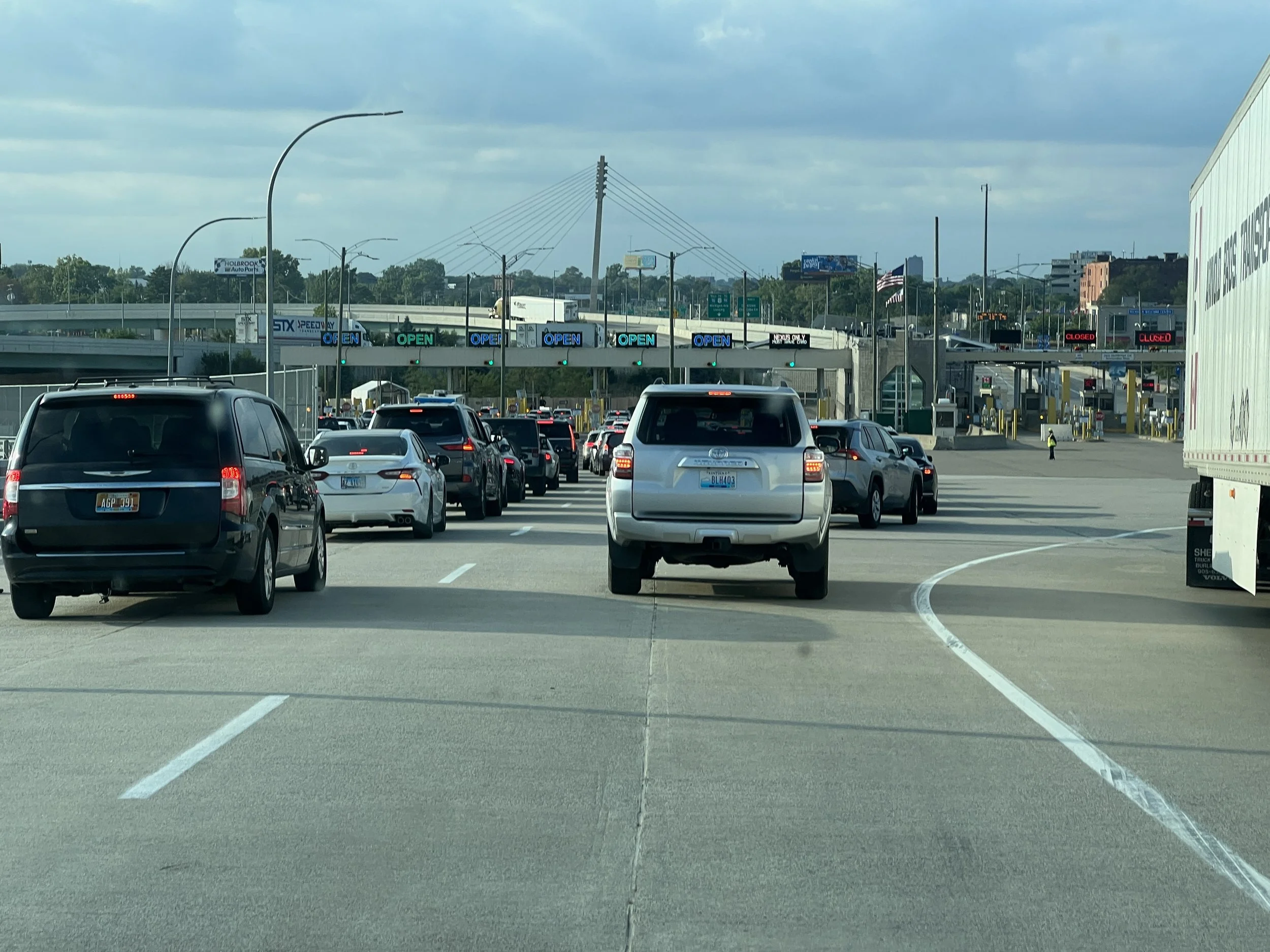
The race for position
The Leather Jacket –Rainbow Bridge Crossing, Niagara Falls
If you know my history, you will know that I was the president of the social club at Sears in Square One. We had many outings, and they grew larger and more elaborate. One such outing was to a very special buffet in Lewiston, New York, just across the Niagara River from Niagara-on-the-Lake. We went there in four cars. The sole purpose was lunch and a return trip. We didn’t have time to shop. It was just lunch and back.
We were a very competitive lot, and we raced everywhere. After lunch, we raced back to the border crossing. Angelo was in the car behind us, zigzagging to get ahead of us in the customs queue. I won the race and was in the car ahead of him by the customs booth.
We had a female border officer, and she asked the usual questions – where we were, how long we were there, and whether we had anything to declare. All were easy answers, since we had been having lunch for two hours and hadn’t bought anything. She was pleasant. As she asked her last question, she dropped her pen. I made a flippant remark, and she laughed out loud. She sounded like she was fun.
Without thinking (something my wife says happens often with me), I told her the car behind us was with us and to search him. She laughed once more and said, “Go away now.” Wanting to see what would happen to Ange, I pulled over and moved slowly. It was obvious she was asking the same questions until he got out of the car and opened his trunk.
Angelo became very animated as he grabbed his leather jacket from his trunk and jumped up and down. He then threw the jacket back into the trunk, got back in the car, sped up, and caught up to us. Once beside us, he rolled down his window and shouted that he was going to kill me. A little later, when we got home, we were friends again. It was then that he relayed the conversation below with the customs guard. Her questions are in bold; Angelo’s are italicized.
· How long have you been away? Three hours
· What were you doing there? Having lunch
· Did you buy anything? No
· Please open your trunk – (Angelo steps out of the car, already put off by the extra step.)
· What is that in the trunk? My leather coat.
· Why is it there? It was too hot to keep on, and I didn’t want to take it into the restaurant.
· It looks new to me. Do you have a receipt for it? What? (Angelo starts jumping up and down) Who carries a receipt for a coat for ten years? Look, I’m telling you it’s an old coat, see the missing button? Or the tear here?
· Oh, put it back. The guys in the car ahead, your friends, put me up to this. Have a nice day.
Author’s note here: This was over forty years ago, when times were different. Unfortunately, we have lost much of our innocence.
Someday, I may also write some of the stories of the famous gang at Sears in Square One.
Fruit concerns
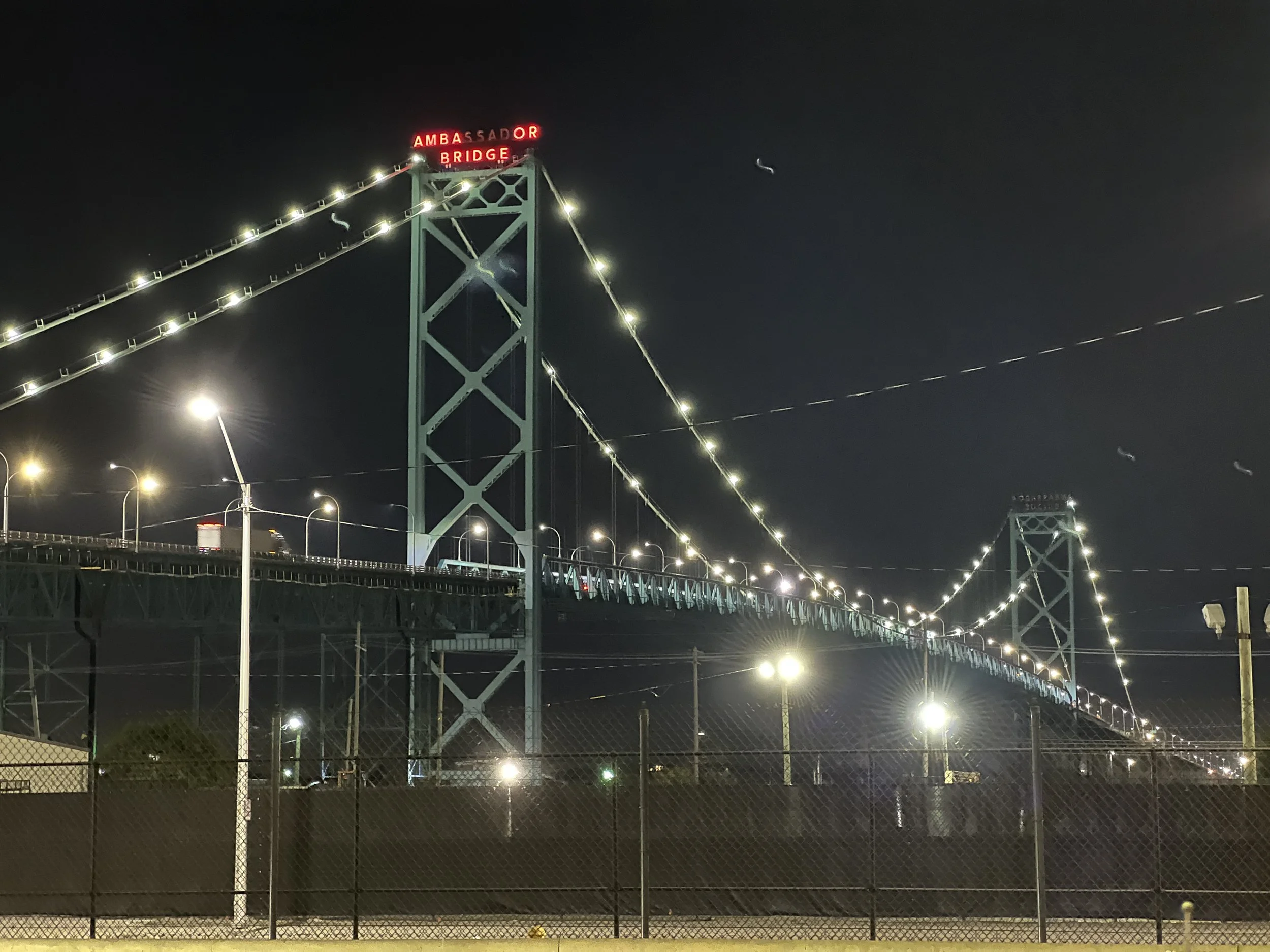
The Green Bananas. Ambassador Bridge, Windsor/Detroit
My father’s passion for car trips was passed down to my children and me. I learned to embrace a good car trip. I have lived by the quote, “Thanks to the Highway System, it is now possible to travel from coast to coast without seeing anything,” attributed to John Steinbeck in his book, “Travels with Charley: In Search of America.”
When I changed careers from retail to financial planning, my first year saw my income drop from over $60,000 to under $19,000. That was also the year Tara needed orthodontic treatment that cost $4,000. We eventually recovered, and I have done very well over the last 33 years. As a result of the financial strain, I would take a map of the Northeastern USA and Ontario, draw an arc with my hand, one finger on Mississauga, and decide to go somewhere within that circle by car. The arc represented an area we could reach within a day’s drive. We could not afford to fly. On top of that, we had to carry groceries instead of eating out. We would have picnics on the road, have great adventures, and see a lot of off-the-beaten-path places.
It was on one of those trips that we were crossing the border in a car full of groceries for our picnics. At the border crossing, one concern is the importation of unapproved agricultural products. The Customs and Border Protection (CBP) agent may refer you to a secondary agricultural specialist. I know that now. I was not aware of that material fact when crossing the border on that trip.
Imagine my surprise when the CBP agent asked me a question I had never heard before. Not only that, but he also spoke very quickly and in a muffled voice. What I heard was a question in which all the words merged into one massive word that simply didn’t register. I asked him to repeat it, and he did, a little louder each time. Still, nothing registered in my brain. When it finally did, it brought a different set of complications. The conversation went like this. His questions are in bold; mine are italicized.
Good morning, where are you headed?/Travis City.
How long are you going to be there?/a week.
Doyouhavenayfruitinthecar? I’m sorry, you’re going to have to repeat that.
Doyouhavenayfruitinthecar? (LOUDER) I’m not sure I understand what you said. Please repeat that.
Do you have any fruit in the car? (LOUDEST) Fruit, oh, I get it. (I asked Donna. Her reply was yes, we do.) I repeated her answer to the CBP agent.
What kind of fruit? Oh, I don’t know, Donna? What kind of fruit? Oranges and Bananas. I relayed the information.
Where are they from? Likely the IGA
No, what country are they from? (Getting exasperated) I don’t know, I can get them out of the back, and we can check.
Are they small green ones or large yellow ones? I figured he was annoyed enough already and replied, “large yellow ones” (I DID NOT SAY THIS, but it took every ounce of self-control in me not to say what I wanted to say). My answer was “large yellow ones.” What I wanted to say was, “At this rate of conversation, they will be brown bananas.”
He simply shook his head and sent us on.
Now I know to listen better for the curveball in the questions.
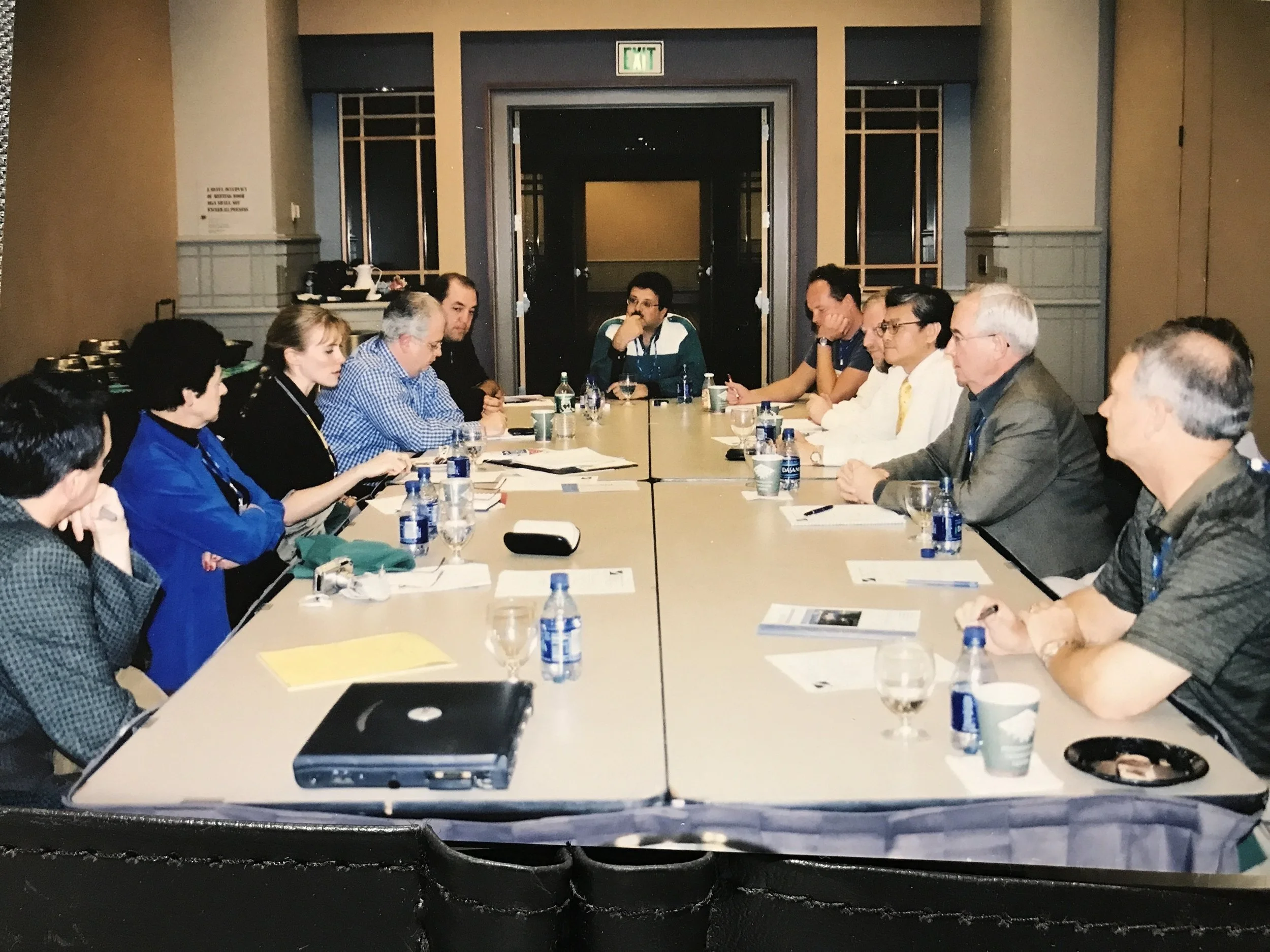
FPA International advisory board committee meeting - with the Musketeers, in Philadelphia 2003
The Musketeers, Rainbow Bridge, Niagara Falls
This story serves as a preamble to the next one and provides background.
In 2000, I joined the Financial Planners Association (FPA), an association for financial planners. At the time, it was the largest in the world, with 30,000 members. Ninety percent were US-based planners, and the remaining ten percent (3,000) were from the rest of the world. It was felt that the association needed a voice for the international attendees, who represented 23 other countries. An advisory committee was formed that divided the world into three regions – Europe, Asia, and the Americas. At first, I was a member of the Americas group. Then I became the head of the Americas group and, finally, the chair of the committee.
In 2003, I invited three other members to join me in Toronto for a financial-planning-focused road trip. We would start in Toronto, hold sessions with other Canadian planners and companies, and then drive together to Philadelphia for the large conference, which would have four thousand attendees. Prior to the start of that large meeting, one hundred and fifty thought leaders would meet and set the course for the association and financial planning for the next ten to fifteen years. We became known as the Musketeers. The Musketeers were Robert Reid from the UK, Maurizio Capra from Italy, Paul Chan from Singapore, and me, representing Canada.
The four of us approached the border crossing, and the most famous one-liners from our group came from Leo Glikin. “I wonder what the odds are of us being stopped for more questions. Do you think we’ll have a hard time crossing?”
When I pulled up, as usual, I tried to explain first, but I was stopped. At some point in my life, I will learn to let the CBP agent lead with their questions, but that was not the time.
When I handed over the passports, I started to explain, but he promptly told me to stop, saying he would be the one asking the questions. He realized there were four nationalities in the car and launched a barrage of questions at all four of us. I guess he didn’t like our answers or had a question, because we were sent to secondary questioning in the building. After about an hour and a half of delays, Maurizio needed a different stamp, which cost seven dollars. All because he had entered the US by plane and was returning by car, or something to that effect. I have no idea of the relevance to this day.
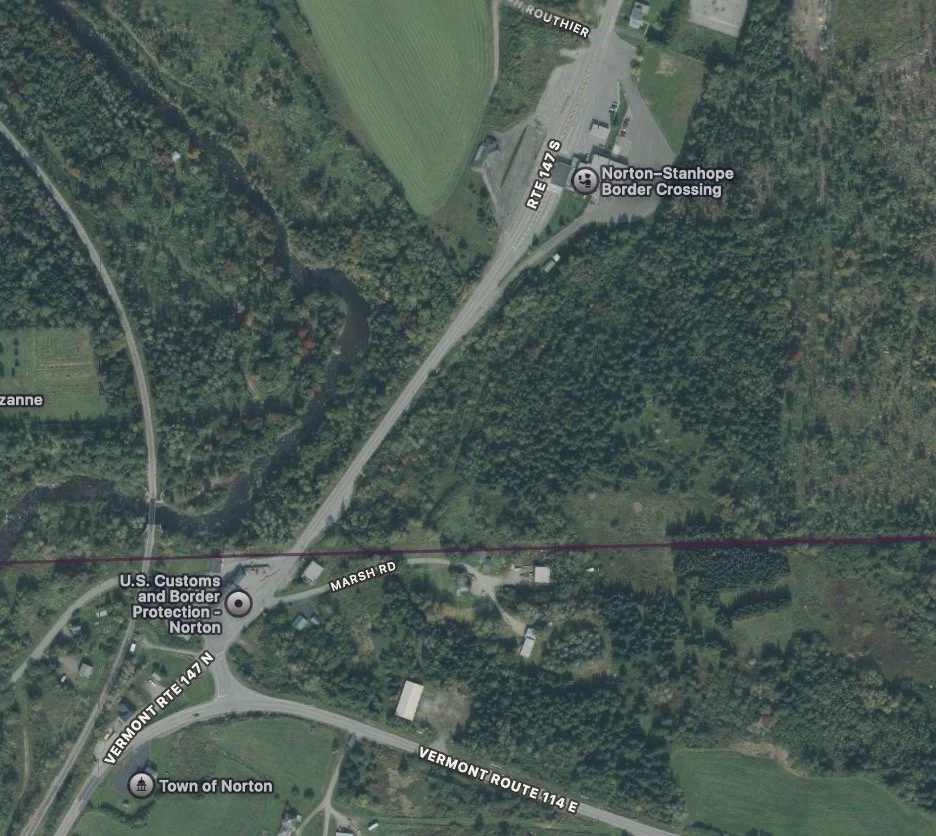
Source: Apple Maps, aerial view of Norton Stanhope border crossing - please note two lane undivided roadway and no standard crossing point.
An unusual border crossing, the Norton - Stanhope border crossing
Not all border crossings between Canada and the USA are massive ports of entry with fifteen to twenty kiosks. The one between Norton Stanhope was unusual. It literally looked like a weight scale stop.
Rob Reid, one of the Musketeers from the previous story, was visiting us with his family and needed a ride from New Hampshire. My daughter Tara and I drove there and picked up Robert and his family. We would have a ten-day Canadian adventure with stops in Montreal, Ottawa, our cottage near Algonquin, and then our home in Mississauga.
The trip to the airport was uneventful. The return trip also seemed uneventful until the border crossing on the way back to Canada.
You need an aerial view included here. You will note that it is nothing like a regular crossing. It was two buildings a few hundred meters apart, with no gates, no barriers, not even a divided highway.
We were unfortunately working on our history of internationals needing a stamp to cross the border. Rob didn’t remember that until we were between the two buildings. He said he would need a stamp from the American side. No problem, I said. It would be easy; I would simply do a U-turn between the two buildings. Nothing could have been farther from the truth. Here is the conversation between the US CBP agent and me.
Again, his words are in bold, mine in italics:
May I explain something before you ask questions? No, I am the one who asks the questions. You answer, but I need. (I interrupted. I still had not learned that lesson.) No, I ask the questions. OK.
Where are you going? Canada.
No, you are entering the USA. Where are you going? (slightly louder) Canada, may I explain? No, I am the one asking the questions. You are now entering the USA, so where are you going? Canada.
OK, let's do it this way: Passports, please. (He asked my passengers now; I was still under a gag order.) Where are you going? Canada. OK, explain to me how you are going to Canada when you are entering the USA. (I finally had the opportunity to say) We picked up our friends from the airport in New Hampshire. We were heading back to Montreal when my friend mentioned that he needed to get a stamp from the US port of entry. He told me that after we passed your building and before we entered Canada. I made what is now the wrong decision. I made a U-turn, and here we are asking for that stamp.
I get it now. OK, but now that you are here, I must admit you to the USA. You don’t need that stamp. Please do a U-turn as soon as you get out. Have a nice day (We left him shaking his head and laughing.)
STAY TUNED FOR Part two, next month, it is all about camera and lens purchases, lunch dates and another U-turn.