Farewell, Dear Friend — Until We Meet Again…
November 18, 2026. I had to say farewell to one of my best friends. I met Myrwood 44 years ago, and there were few years when we weren't together for one adventure or another. The article below has already been published — but I wasn't finished. It was the first of two parts. Today, as we bid farewell to Myrwood at his funeral, I'm adding part two and combining them in one final tribute.
I had the honour of giving the eulogy today, and I distilled a 45-minute speech into five. The words below are basically some of the stories I would have said in a 45-minute speech - nobody would have had the tolerance, including me, to read or listen to me for that long. Even Myrwood would have shot me. The following stories about Myrwood and my adventures are not in any order.
A note before you begin: this is a long story. It is a forty-four-year journey — from a chance meeting in 1982 to a farewell in 2026. Read it in one sitting, or come back to it piece by piece. The stories are not in any particular order, and each one stands on its own.
I told the young people in attendance today that in the coming days, weeks, months, and years, little treasures will remind them of Myrwood. It could be something funny, and they'll get a chuckle — or something sad, and they'll tear up. Celebrate those. They're indications from the universe that he's with you, and that you need to remember the fond times.
Indeed, we had an incredible number of stories. What I wrote in the previous article, and what I've added in this one, are just a few. Not many days go by without me thinking of another stupid little adventure, wicked card game, or something that happened. At the risk of upsetting readers, I don't want to overdo it, so I'm keeping it short. I, for one, will remember - and think of Myrwood every time I look out that seven-foot window at the cottage, the one in the story below, called "The Seven-Foot Window," and remember the customer service manager at Home Depot calling him my father. I'll chuckle every time I look out that window. Thanks for the memories, buddy.
Part One: How it all began
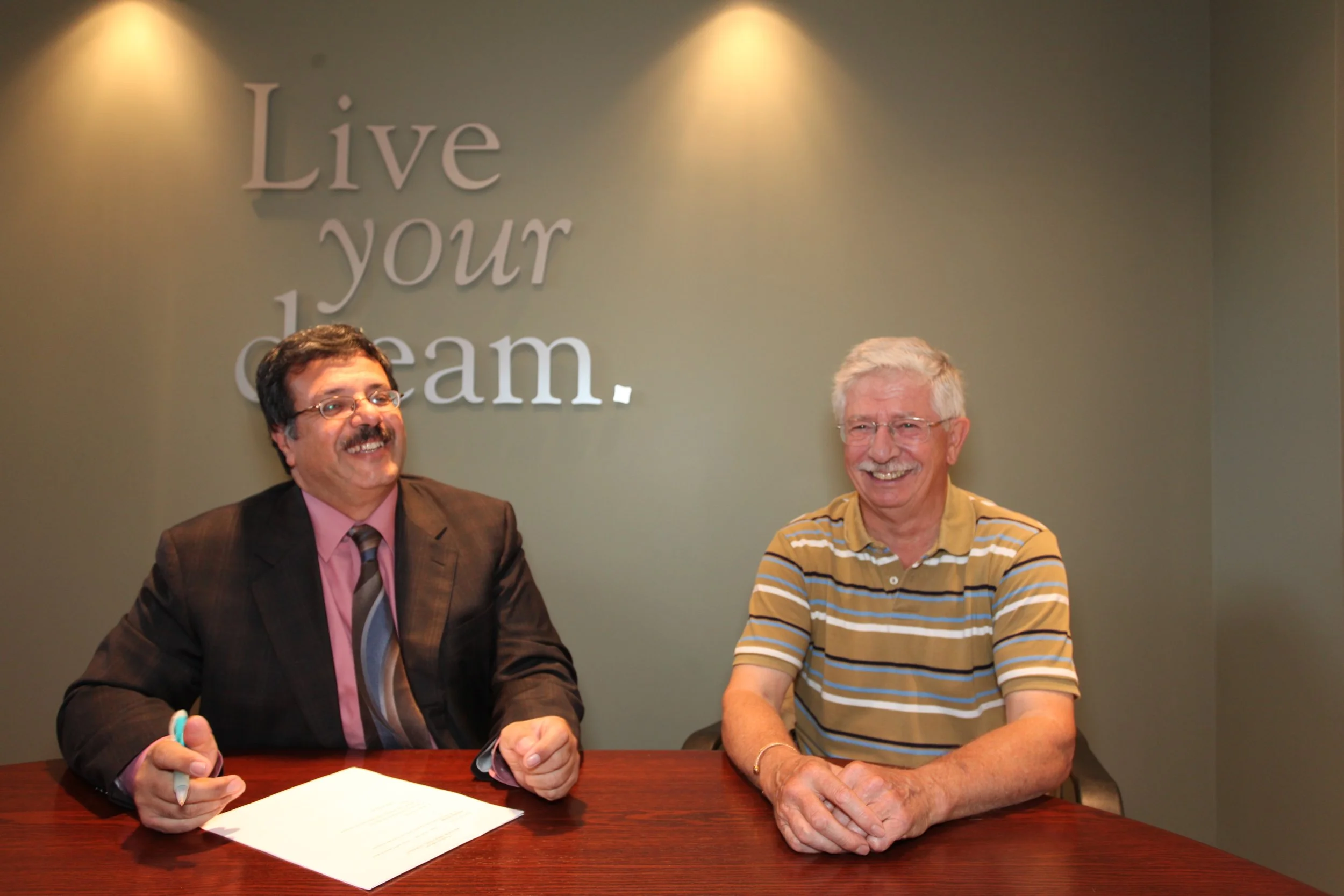
At my branch office, which Myrwood renovated.
A Chance Meeting, a Friendship, and a Life-Changing Phone Call
Once in a while, we meet someone with whom we share an instant connection. This story is about one such connection, crossed paths and forks in the road. It is about a four-decade-long friendship.
The sheer number of coincidences cannot possibly be accidental; I have to believe that a higher power is at play. I simply cannot list them all here in a short story. Believe me when I say the list is much longer than this story can cover.
In 1982, Donna and I decided it was time to redo the stairs at the front entrance of our home. I began exploring the many options available, trying to determine what would be both practical and, hopefully, attractive.
One of our neighbours was planning to get an estimate for a precast-concrete stair system. They told me when the representative was coming and suggested that I keep an eye out for him. If I was interested, I could have him take a quick look at our stairs while he was there. As it turned out, he arrived exactly as expected.
It was a beautiful, sunny, midweek morning. I happened to be home because I was working the evening shift in the Sears carpet department and didn’t have to leave for work until just after noon. I approached the representative, and he said that once he finished measuring our neighbour’s property, he would come across the street and have a look at ours.
True to his word, he did.
During our conversation, he asked the obvious question: why was I home in the middle of a weekday morning instead of being at work? I explained that I worked at Sears and was scheduled for the evening shift.
He chuckled and said, “My wife works at Sears, too.” At that time, Sears was at the height of its success. I don’t recall the exact number of employees, but there may have been 40,000 people working for the company. So, I asked where his wife worked. “The carpet installation department in Rexdale,” he replied.
He probably wasn’t expecting my next question. “Is her name Carol?” The look on his face was priceless. I worked in the carpet department, selling installed broadloom. I would frequently wander over to the installation department at the warehouse—not always for strictly business reasons. I had become friends with all the women who worked there, and one of my good friends was Carol.
Carol was his wife. His name is Myrwood Scott.
Neither of us could have known it at the time, but that chance encounter over a set of front stairs was about to become the beginning of a friendship that would span more than four decades.
As it turned out, I didn’t think Myrwood’s precast-concrete solution was the right answer for our stairs. But the stairs themselves became almost irrelevant. The important thing was that I had met Myrwood.
Not long afterward, an opportunity came up to hire a new salesperson in the Sears carpet department. Myrwood immediately came to mind. I contacted Carol and asked if she thought her husband might be interested in applying. He was.
With his background in outside sales and my recommendation, Myrwood was hired. And so began a friendship that has become one of the enduring relationships of my life.
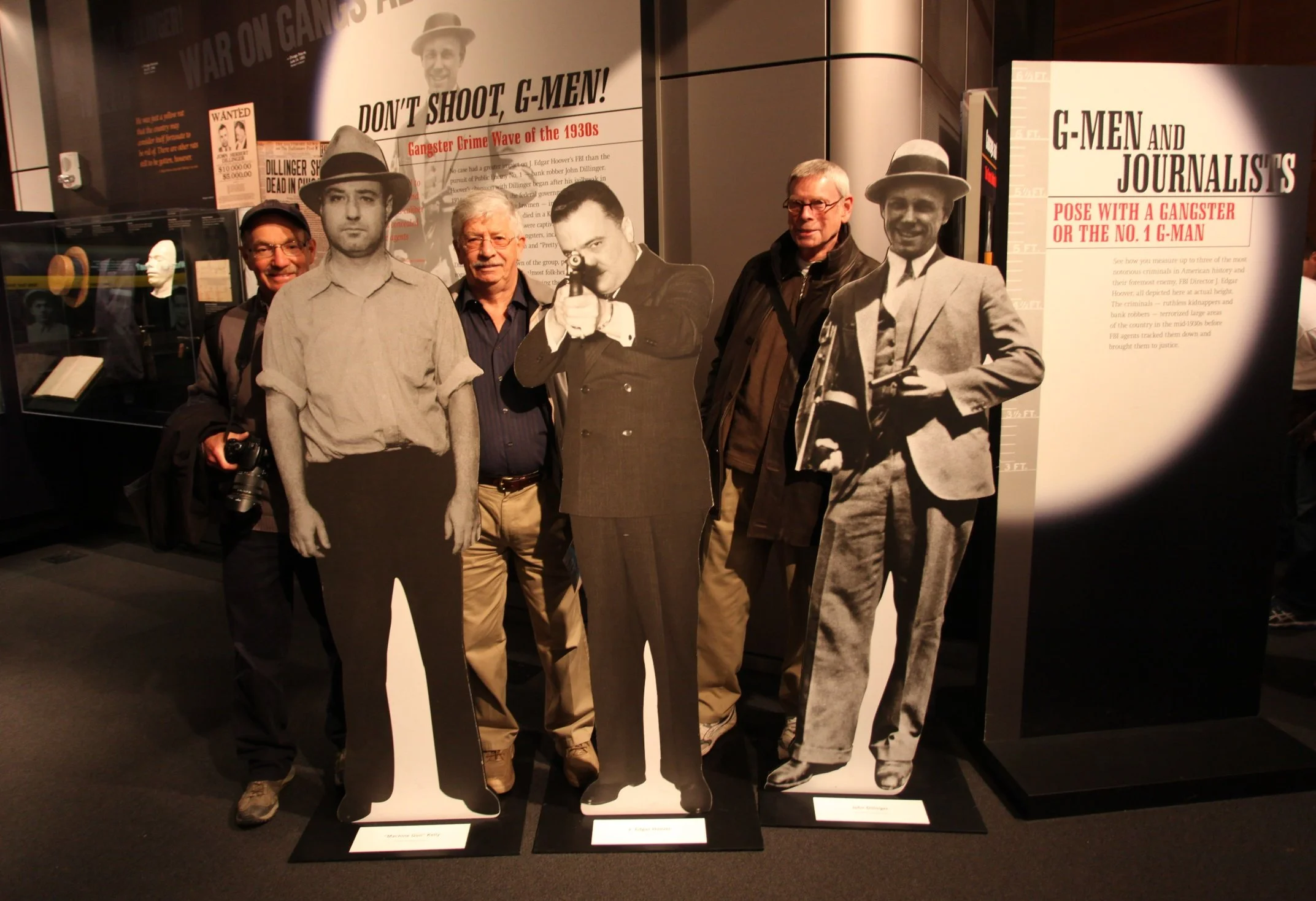
At the Newseum in Washington DC
Four Decades of Stories
Since that day, Myrwood has played a significant role in my life. We have travelled together, shared countless meals, celebrated milestones, endured frustrations, and—perhaps most importantly—collected an extraordinary number of stories.
Some are touching.
Some are ridiculous.
Some are probably best left to the imagination.
And some make me wonder how we ever got away with them.
What follows is a selection of the more memorable activities, trips, adventures, and antics that Myrwood and I shared over the years.
It was never entirely safe when the two of us were together.
I should add a small disclaimer before proceeding. Some of the antics from our Sears days would not happen today. Some would not even be considered appropriate, and a few might have crossed the line into illegality.
Myrwood was one of the first people I approached to be included in my first published book, “Ordinary People, Extraordinary Lives.” You can read The Essence of Myrwood Story by buying the book or following this link:
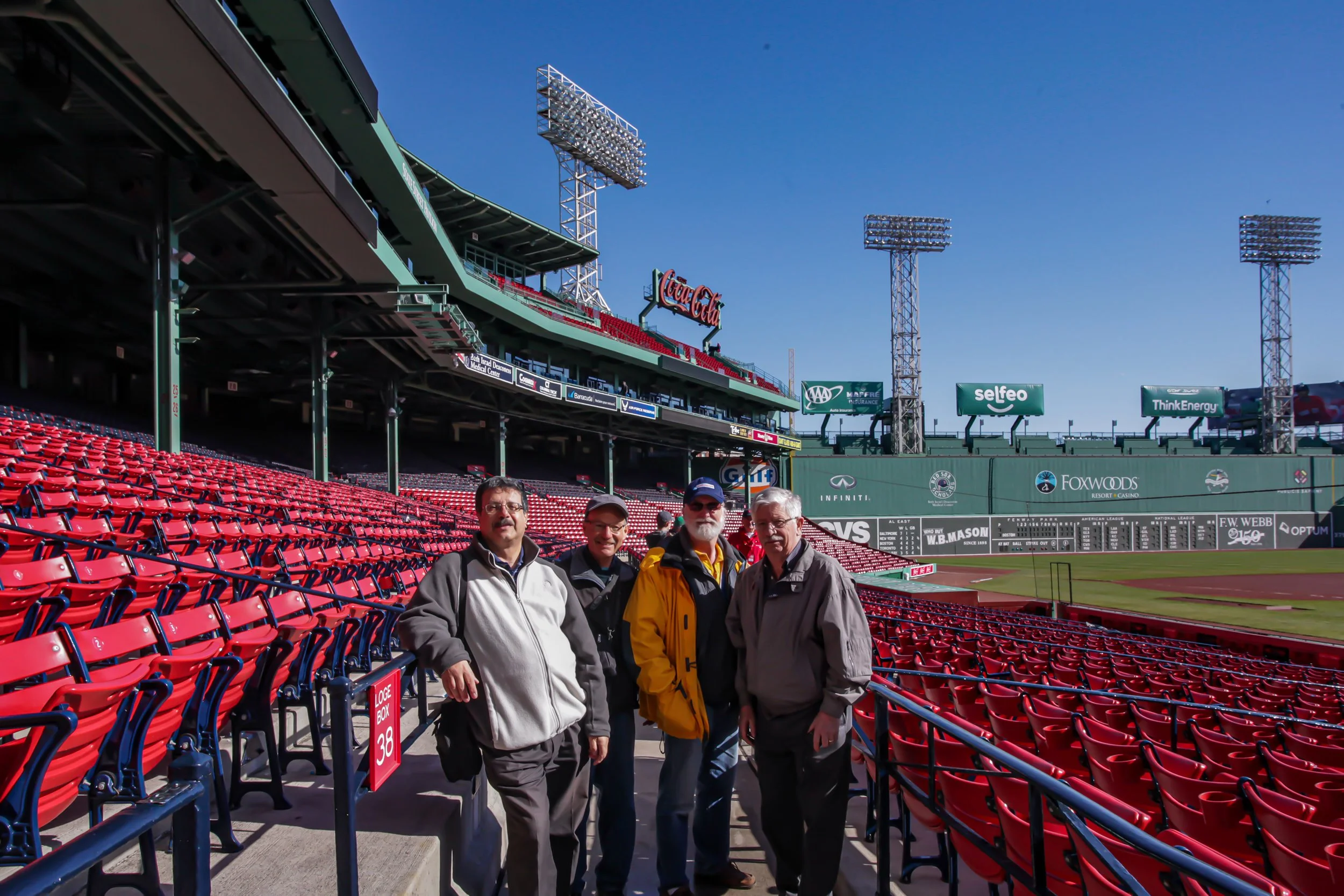
One of the many trips. Fenway Park was a dream trip.
I am not passing judgment on the people we were then or the people we are today. At the time, many of these things were simply considered fun, and some were accepted as part of workplace culture. Looking back now, I can certainly see some of them from a different and more sensitive perspective.
The stories that follow are not presented chronologically. They come from different periods of our friendship and are grouped by theme and not date. They are really a collection of memories, with Myrwood as the central character and me, more often than not, standing somewhere beside him.
But among all those memories, one stands apart.
It is the story of a phone call that changed the direction of my life.
The Phone Call
One of Myrwood’s most important contributions to my life was introducing me to Ed Tower and, ultimately, to a career in financial planning.
My interest in finance had developed gradually. In the late 1980s, I had an unfortunate experience as an investor. It made me think carefully about the relationship between an investment, its suitability for the investor, and the cost of doing business.
I decided I would never again invest in anything I didn’t understand. My answer was to educate myself. I began taking industry courses in finance, investing, and financial planning. I became increasingly fascinated by the subject. Since I had no intention at the time of making it a career, I never bothered to write the exams.
That was a decision I would eventually regret.
Interestingly, the idea of a career in financial services had actually crossed my mind as early as 1982. But Donna and I had a two-year-old, and a career change simply wasn’t in the cards. Family came first, as it always has.
Ten years later, however, circumstances—and one particularly bad day at Sears—would change everything.
It was the summer of 1992, and I was having an absolutely terrible day at work. I used to joke that everything I touched turned to dirt. The problems were all solvable, but there comes a point when even solvable problems become too many problems. I had reached that point.
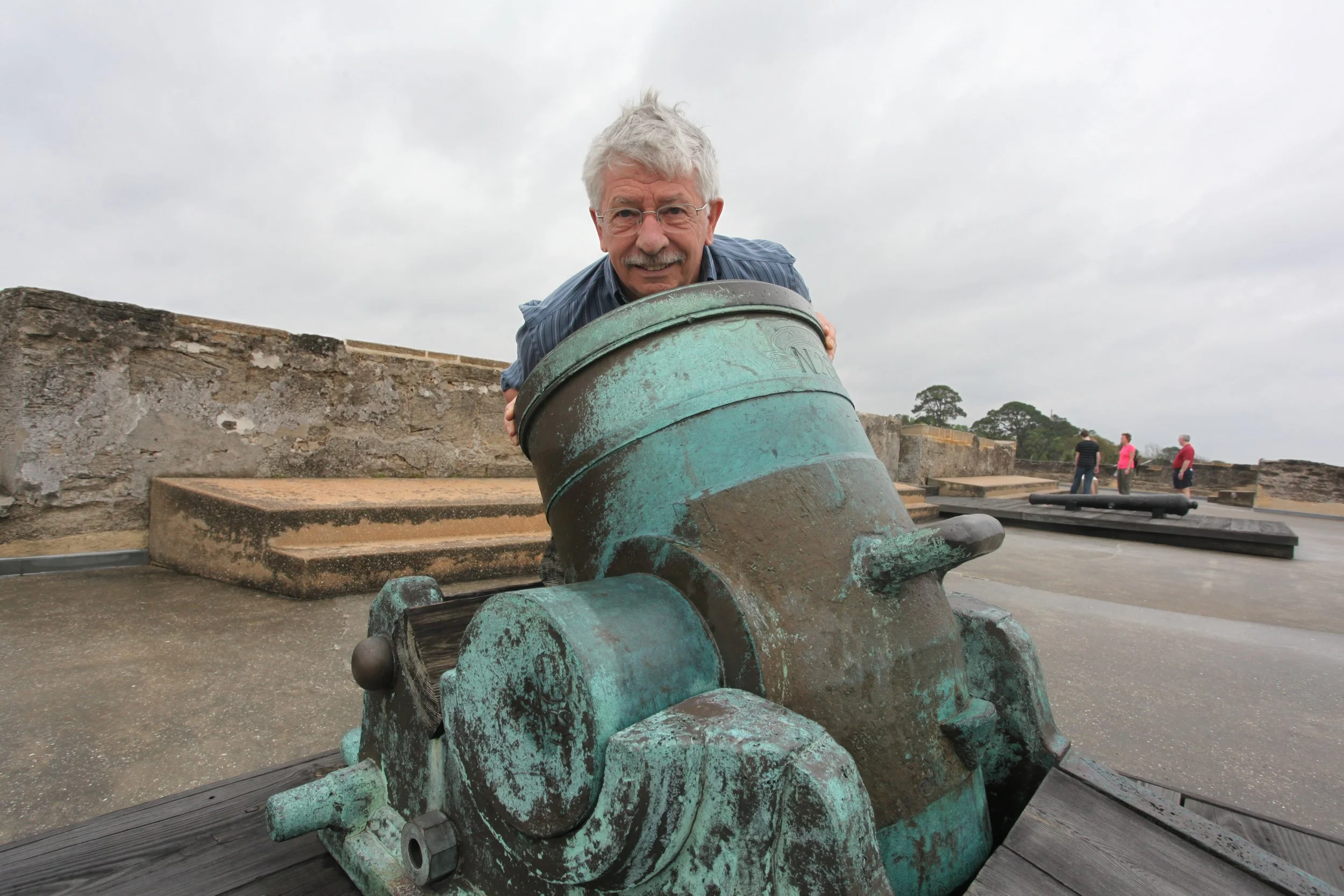
It always amazes me what my friends are willing to do when I have the camera and direct them. At Castillo de San Marcos in St. Augustine, Florida.
Myrwood and I shared season tickets to the Toronto Blue Jays. That evening, he picked me up and we headed to the game. As if the day hadn’t already provided enough frustration, we got stuck in traffic.
I was becoming increasingly exasperated when I finally blurted out: “I’m tired of playing store. I want to do something I really enjoy—like financial planning.”
What happened next is my favourite Myrwood story.
There was absolutely no pause between my statement and his response. Myrwood reached for his car phone—a magnificent, brick-sized contraption that seemed better suited to a construction site than the passenger seat of a car—and immediately made a call.
I knew it was someone he knew well because of the way he answered the phone: “Hi, you horse’s patootie! How are you?” That was Myrwood.
At this point, Myrwood had already left Sears and was working elsewhere, once again selling concrete steps. After a little friendly banter, he got to the point.
“Naguib Kerba is in the car with me. He’s thinking about a career change and going into financial planning. Would you mind talking to him?” Then he handed me the brick.
His introduction was about as formal as Myrwood ever needed it to be: “Naguib, meet Ed Tower. He’s a good person to talk to.”
And so, I talked to Ed. We spoke for only a few minutes. At the end of the conversation, Ed asked me to meet him at his office in a couple of days.
I did. And in what would become one of the most consequential meetings of my life, Ed hired me on the spot.
No résumé.
No lengthy interview.
No elaborate career plan.
Myrwood had already told Ed enough about me that he was willing to take a chance.
There was, however, one condition. I had to write a licensing examination. If I passed, they would pay half my course fees, and I would have a job. I passed the exam at the end of August.
On September 2, 1992, I began my new career. The rest truly is history.
What began ten years earlier with a chance encounter over a set of concrete stairs eventually led to a 33-year career in financial planning.
The pivotal moment came while two friends were stuck in traffic, when one of them decided my offhand complaint was actually a career plan—and immediately picked up a phone the size of a paving stone to do something about it.
That’s Myrwood.
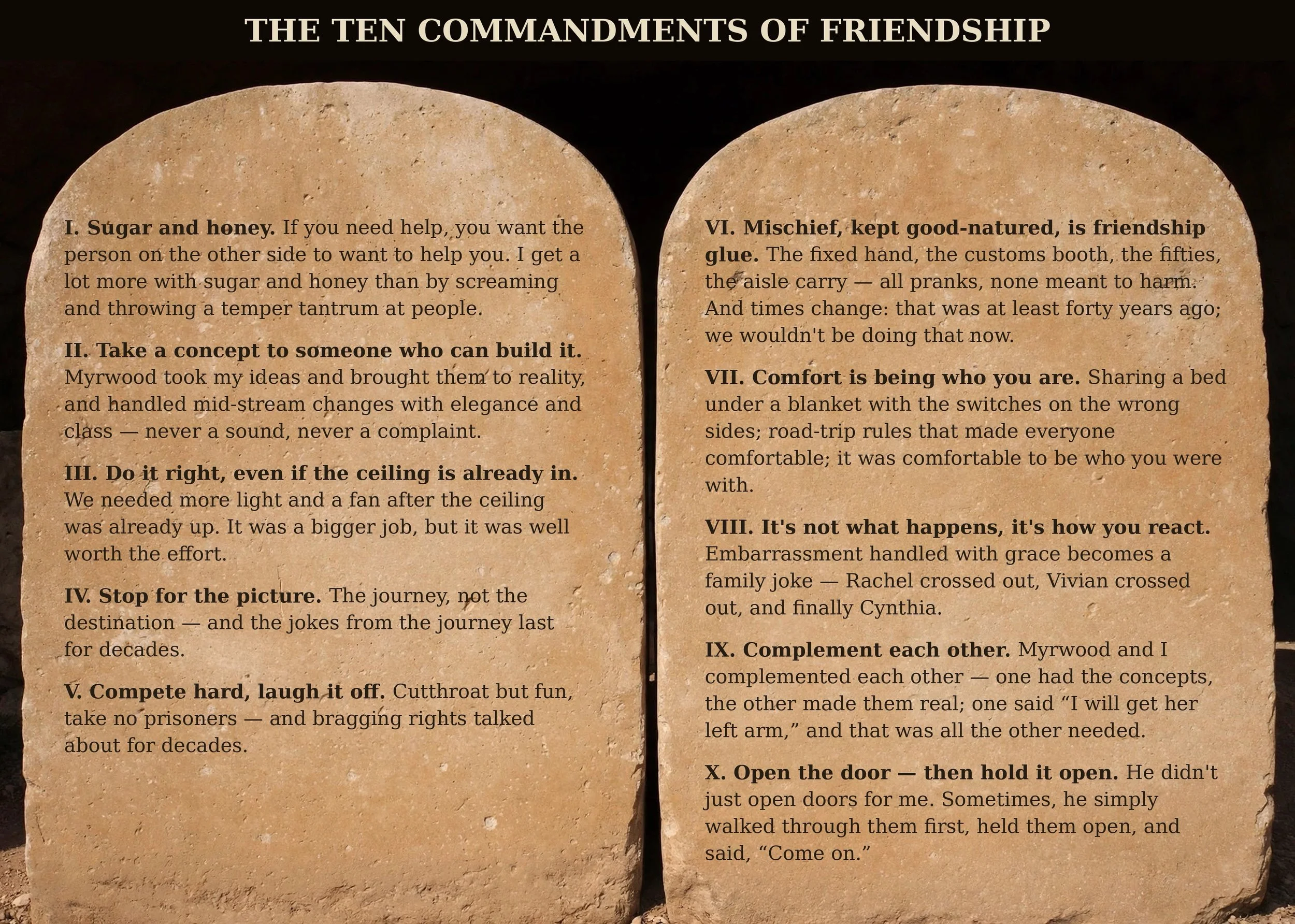
He didn’t just open doors for me. Sometimes, he simply walked through them first, held them open, and said, “Come on.”
And for that, and for the friendship that began that sunny morning in 1982, I will always be grateful.
The Adventures Continue
My career in financial planning eventually took me well beyond the office. Through my involvement in three professional associations, I had the opportunity to contribute to the profession at both the national and international levels. Those efforts were ultimately recognized when I was awarded the designation of Fellow of the Financial Planning Association (FPA), an honour reserved for those who have made a significant contribution to the profession.
Throughout those years, Myrwood and his wife, Cynthia, were two of my most trusted sounding boards. I often spoke with them when I was considering a new idea, developing something I wanted to introduce to clients, or simply needed another perspective. They were always willing to listen, challenge an idea, or offer an opinion. Sometimes you don’t need someone to give you the answer—you just need someone you trust enough to ask the question.
Two Cynthia Stories
After Myrwood's divorce, he moved to 3100 Kirwin and was dating. Of course Donna and I would go out to dinner with whoever he was dating at the time. Whoever he dated, we liked. One was Rachel, and we went out together several times, and she was delightful company. But alas, that wasn't meant to be — they eventually broke up.
One trip shortly after that breakup, we were going to the cottage, and I was picking Myrwood up from the apartment. I got there, and all his gear was on the sidewalk. As we packed the gear, he stopped, looked up, and waved. I asked, "What are you doing?" "Just waving goodbye to Cynthia." I knew then he was over Rachel. I knew that he was hooked that day, and I pestered him the whole trip. Cynthia was the best thing that happened to him.
The rest is history — but it left one more story to share, one that lived in the family forever.
We loved Cynthia, which is a good thing since Myrwood eventually married her. Of course, I was honoured to photograph the wedding. But one awkward moment happened. As I stood trying to arrange people for a group picture, I mistakenly called Cynthia “Rachel”. She immediately took me by the shoulder and corrected me. Of course I was embarrassed. David, Myrwood's son, had a lot of fun with that — until it was his turn to say a few words. He stood beside me as I took pictures of his speech, and in it, he said he was glad his dad was with Vivian. No one could figure out who that was. He was talking about Cynthia and got her name wrong. Karma is such a bitch! To this day, Cynthia is often called Nana Viv. At the next euchre tournament, we had name tags. Cynthia's tag had Rachel crossed out, then Vivian, and finally Cynthia. The takeaway is that things will happen—it's how you react.
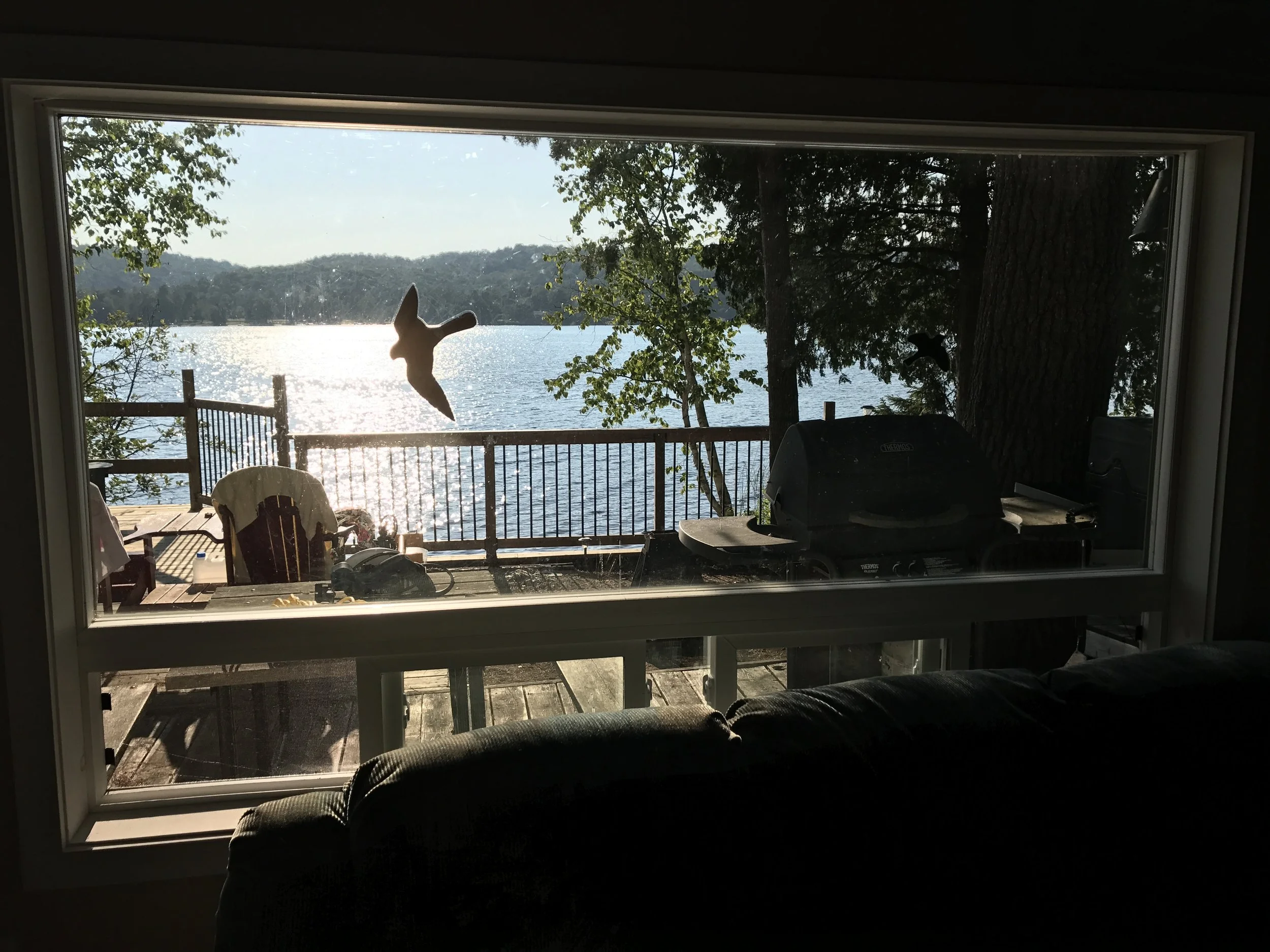
The view
Part Two: The Builder
The Seven-Foot Window
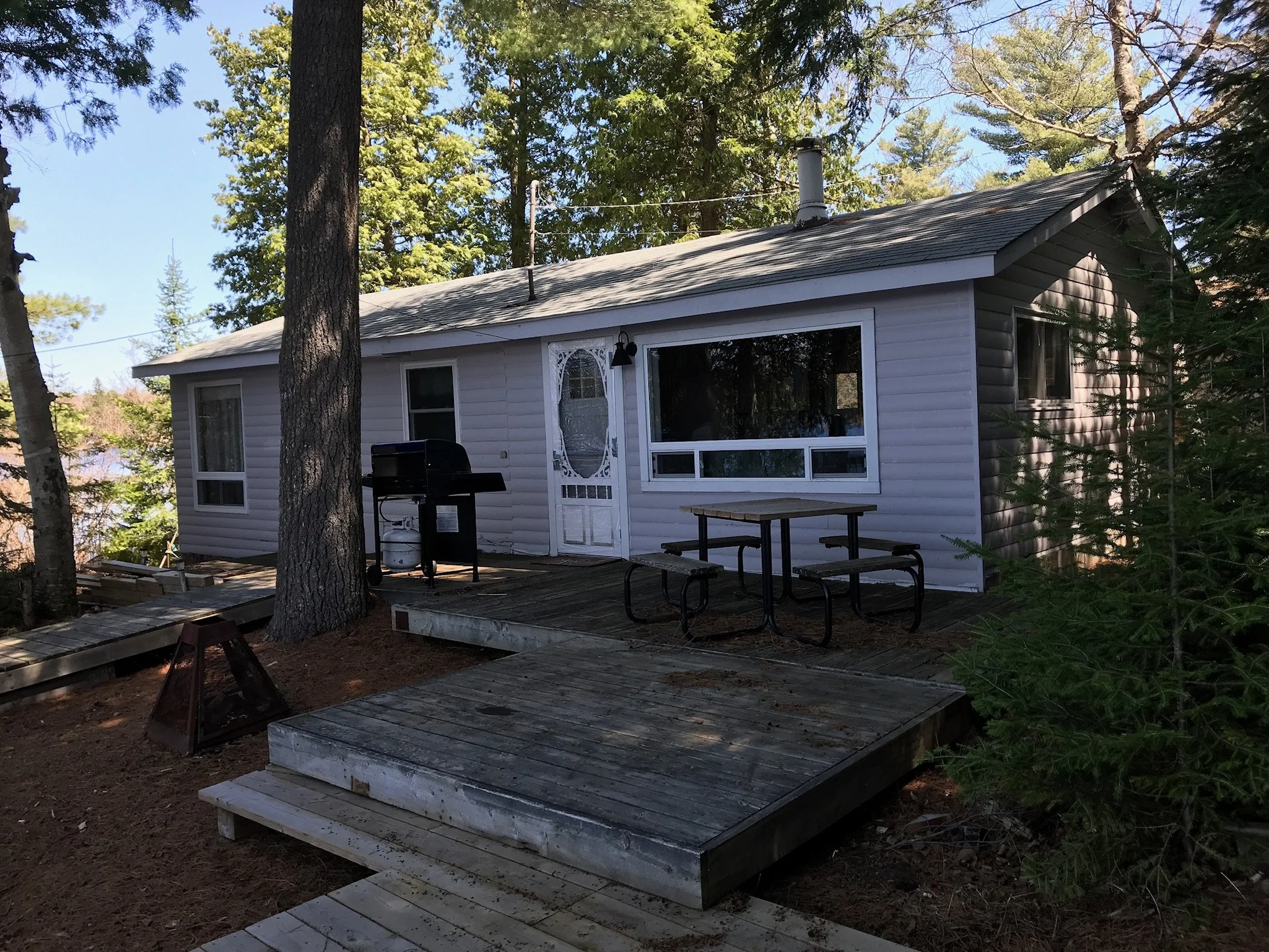
We were renovating the cottage, and Myrwood, as usual, was my go-to guy for project management. We wanted a beautiful seven-foot-wide window, so we ordered one from Home Depot. It must have been nice, because the staff may have stolen the first one when it arrived, and the second took forever to show up. It was a real challenge: we lived without a window for three months. We had literally torn out the entire wall to accommodate it. We propped up the roof, removed the old wall, and rebuilt it for the new window—but until the project was finished, we lived with plywood.
I had numerous calls with customer service, sometimes two or three a week. Along the way, I developed a great bond with the customer service manager, a woman at Home Depot. She told me how much she appreciated how I handled the situation — she couldn't believe how nice I was to her every time we talked.
That's always been my theory with customer service. If you need help, you want the person on the other side of the phone to want to help you - not dread your call or refuse to pick up. I've used that approach all my life. I get a lot more with sugar and honey than I do by screaming and throwing a temper tantrum at people. Yes, it's frustrating, but they're trying to help, not to hurt, and I acknowledge that every single time. After the window was finally available and installed, I needed to go into the store and get a store credit for all the trouble we went through. In the end, instead of giving me a few dollars off the window, she used her discretion — and gave us a full credit for the purchase price of the window.
I went into the store with Myrwood in tow to thank her and settle on the adjustment, and we had a really nice chat, with him right there as part of the conversation. Then she asked where I was going with my father. As I started to laugh, Myrwood cringed. He shook his head and said, "Oh boy." I said, "Well, I want you to know you've made my day — but you've ruined the rest of his life. He's my friend, not my father." It seems that often, or every time I look out that window, I am reminded of Myrwood being called my father, and I chuckle a little.
Every time I look out of that window, it reminds me of my “Dad,” Myrwood.
Turning an Idea into Reality
The great thing about Myrwood was that he was one of the guys I could take a concept to, and he would bring it to reality. But more than that, he handled mid-stream modifications with elegance and class — never a sound, never a complaint.
I have two examples of that. When Myrwood and the gang were renovating the office, we closed an outside door and reworked a straight staircase into a landing, a turn, and then two steps. It would be stunning!
But that turn created a space that would have been totally wasted and walled off. And then Mr. Concept Man, yours truly, had a thought: this would be perfect for an open cavity to display a sculpture of eagles I had acquired. It would add a huge touch of class.
It would also make for a lot more work. It would mean he would have to cut into the framing, create an inset into the wall, and build an open, lit cavity where the door was. Mid-stream, Myrwood saw how good the idea was and, without reservation, made it happen. It was the pièce de résistance, and the whole new look was only possible because I had a person who could take a vision and deliver on it.
A Bathroom to Be Proud Of
Back to the cottage renovation. We had wasted space in our bedroom, and a deep closet. On the other side of the wall sat a very small bathroom with a regular tub-and-shower combination. It was another boys’ week at the cottage; we were changing where the bedroom stopped and the bathroom started.
My idea was to take the extra space from the bedroom and put in a really nice corner shower. Myrwood and the gang came up and, of course, did exactly as asked. But midway through, we realized two things: we needed more light and an exhaust fan. The ceiling was already in by then, but I thought it would make more sense to have both anyway. So Myrwood sent me off to the store to buy the exhaust fan/light combo. Fitting it was a bigger job, but as we laughed about it later, it was well worth the effort. Of course there were problems with the order, but in the end all is fine, and now we have a bathroom to be proud of. Myrwood, to his credit, took the change of plans with the same attitude as always.
Part Three: Sears
The Sears Family
Back in the mid-to-late 1980s, Sears at Square One was home to an extraordinary collection of people. We were colleagues, but we became much more than that. Many became lifelong friends.
It wasn’t simply a workplace. It was an extended family.
We worked together, partied together, and eventually vacationed together. At first, our adventures were relatively modest: fishing weekends at our cottage, ice fishing, and other outings. As the years went by, however, our ambitions—and our destinations—got bigger.
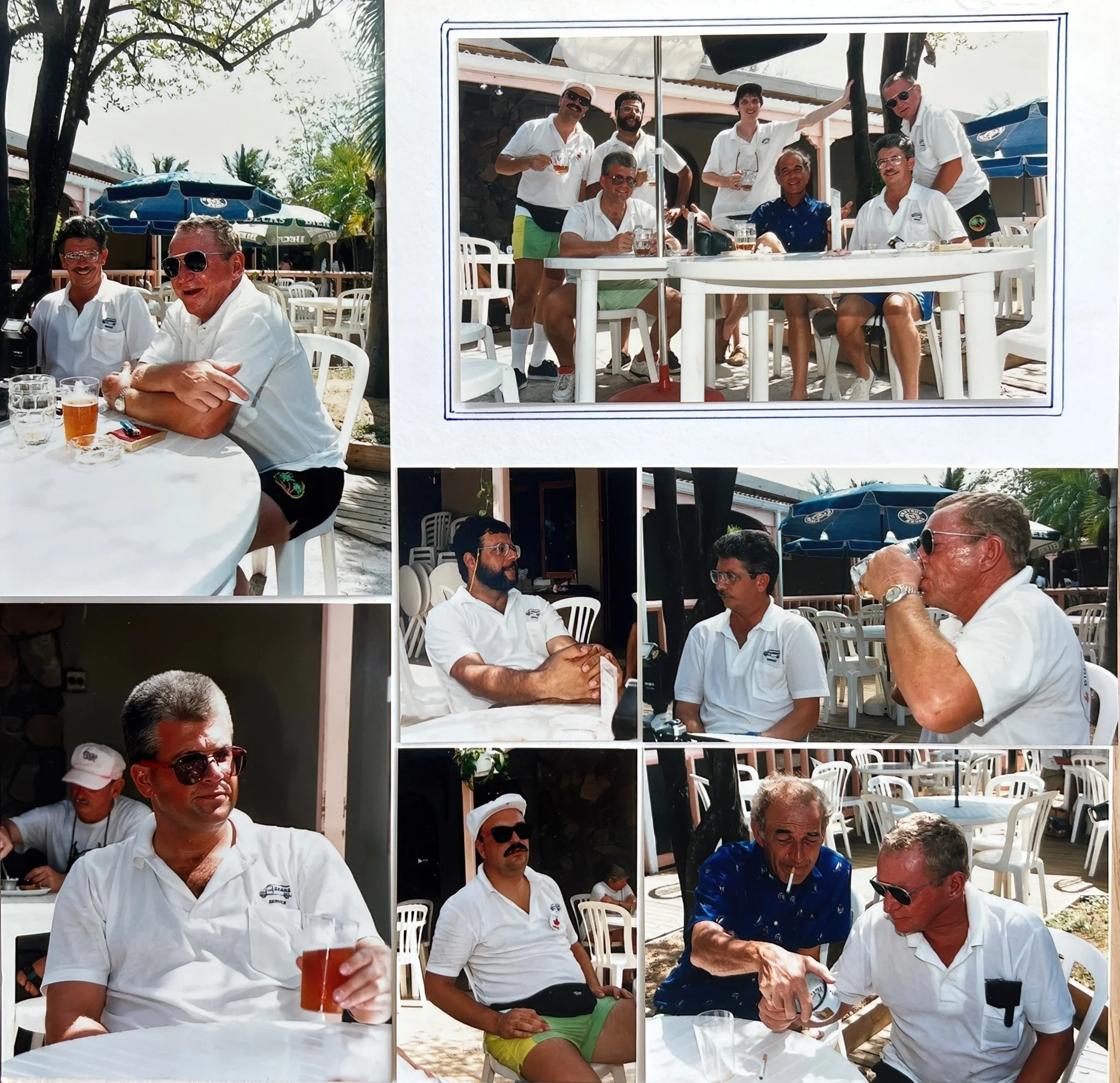
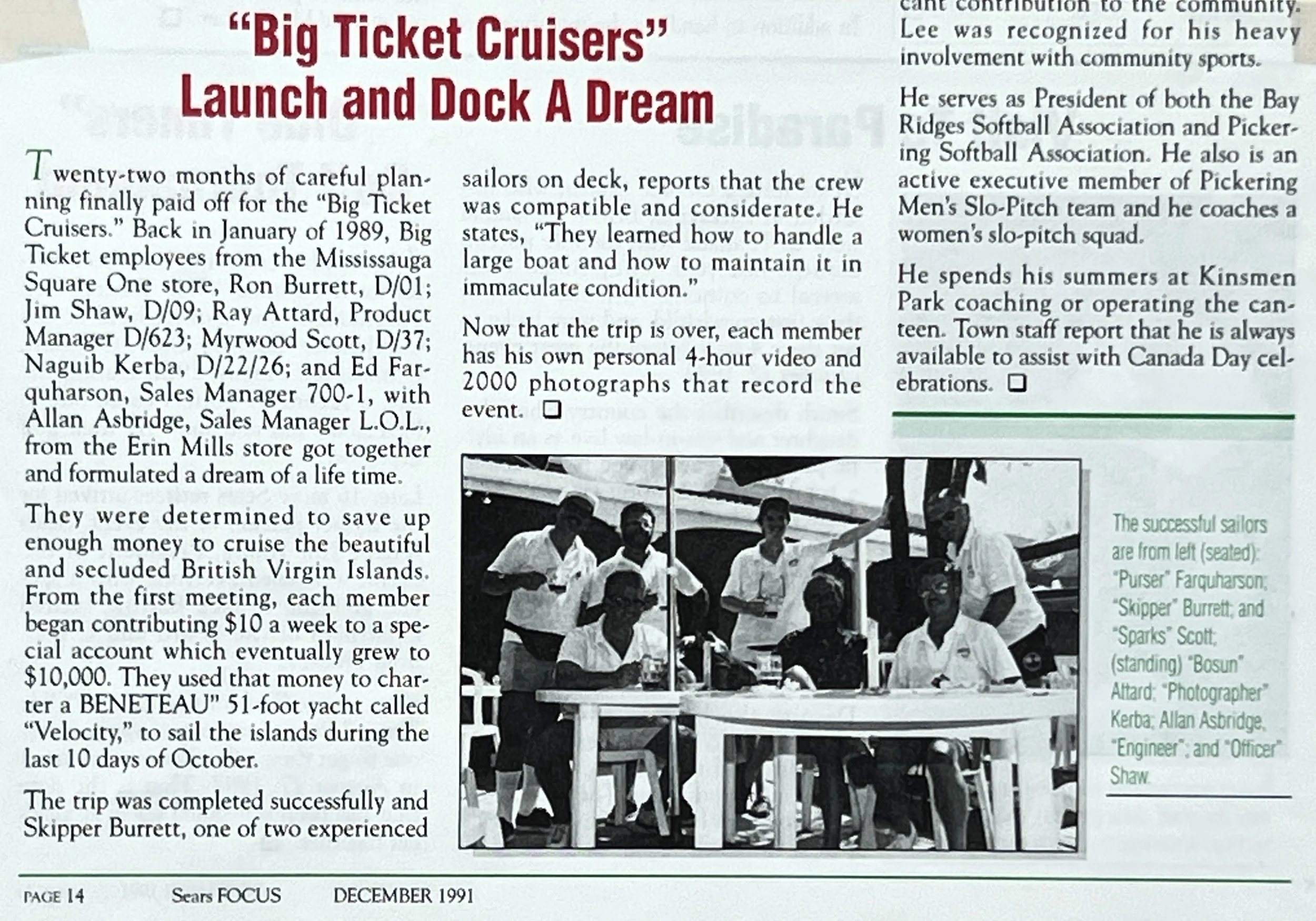
One of those adventures became known as The Big-Ticket Cruisers.
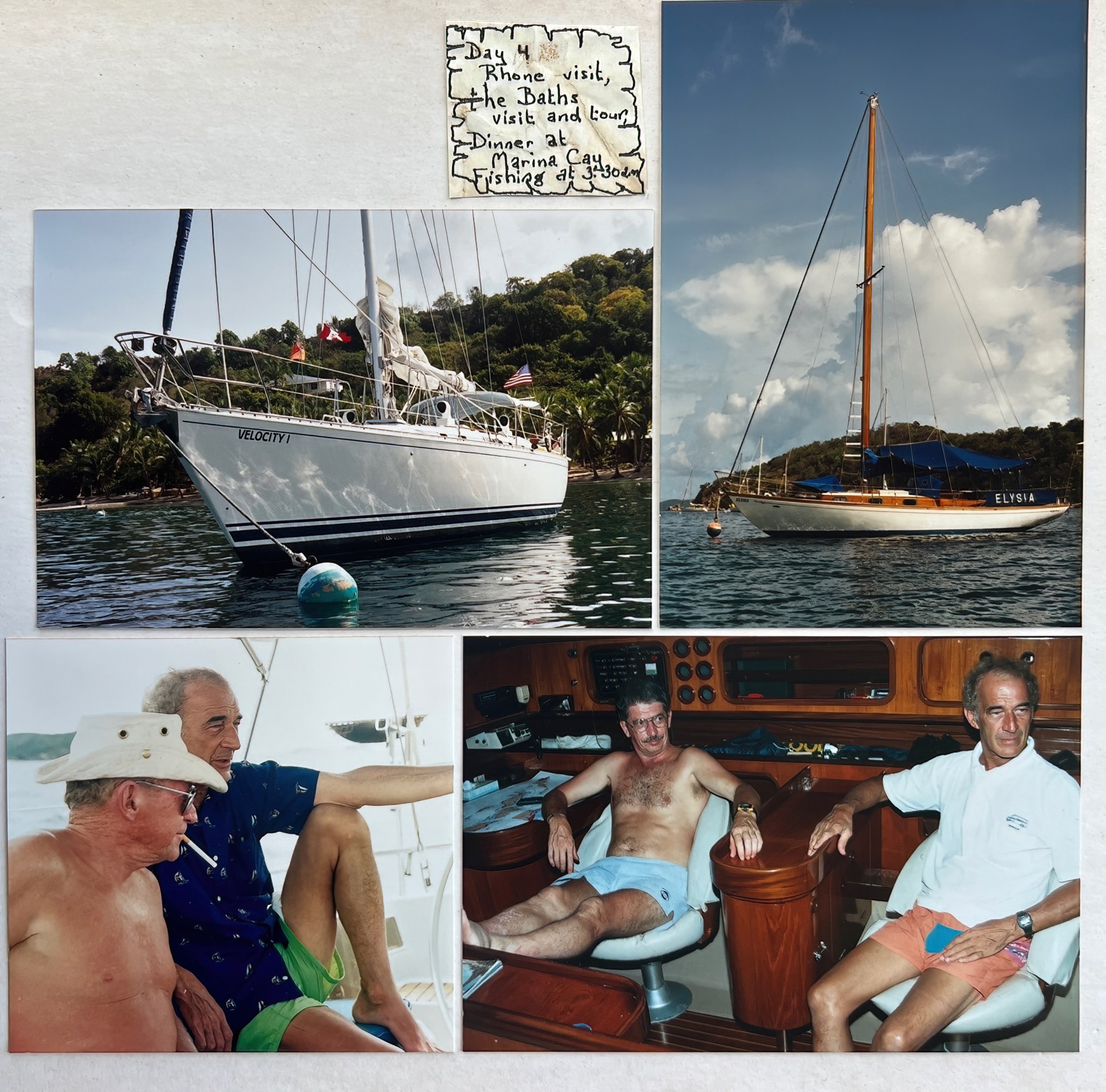
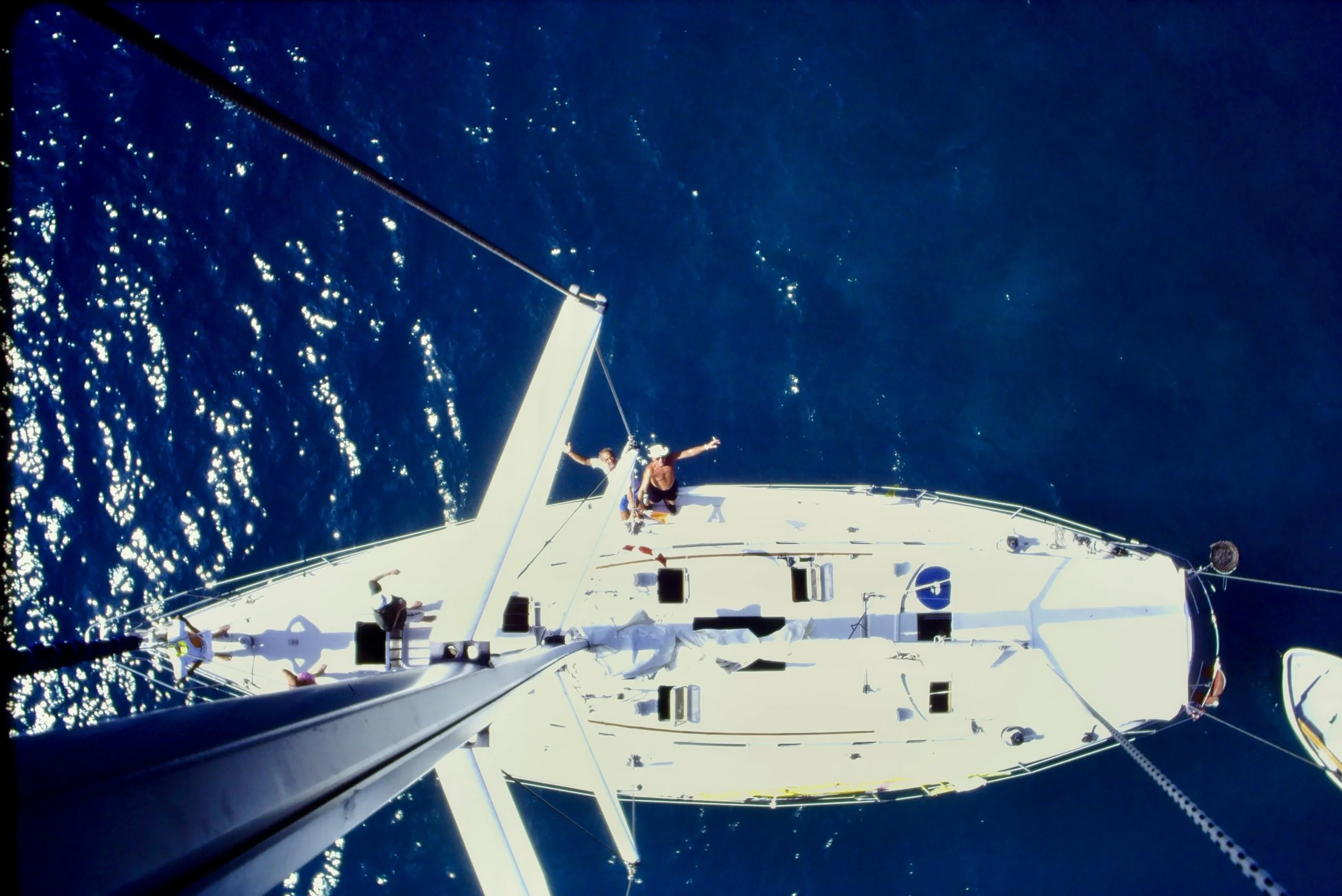
Seven of us saved $40 or $50 a month and pooled our money until we had enough to take the trip of a lifetime. We flew to the British Virgin Islands, chartered a sailboat, and spent seven days sailing around the islands.
The full story deserves its own chapter—and, in fact, it already has one in my blog under the same name. But since this is a story about Myrwood, I can’t resist including a few of his contributions.
Who had the last and longest laugh now?
The All-Star Game
The Sears group also gave us another great tradition: Blue Jays baseball.
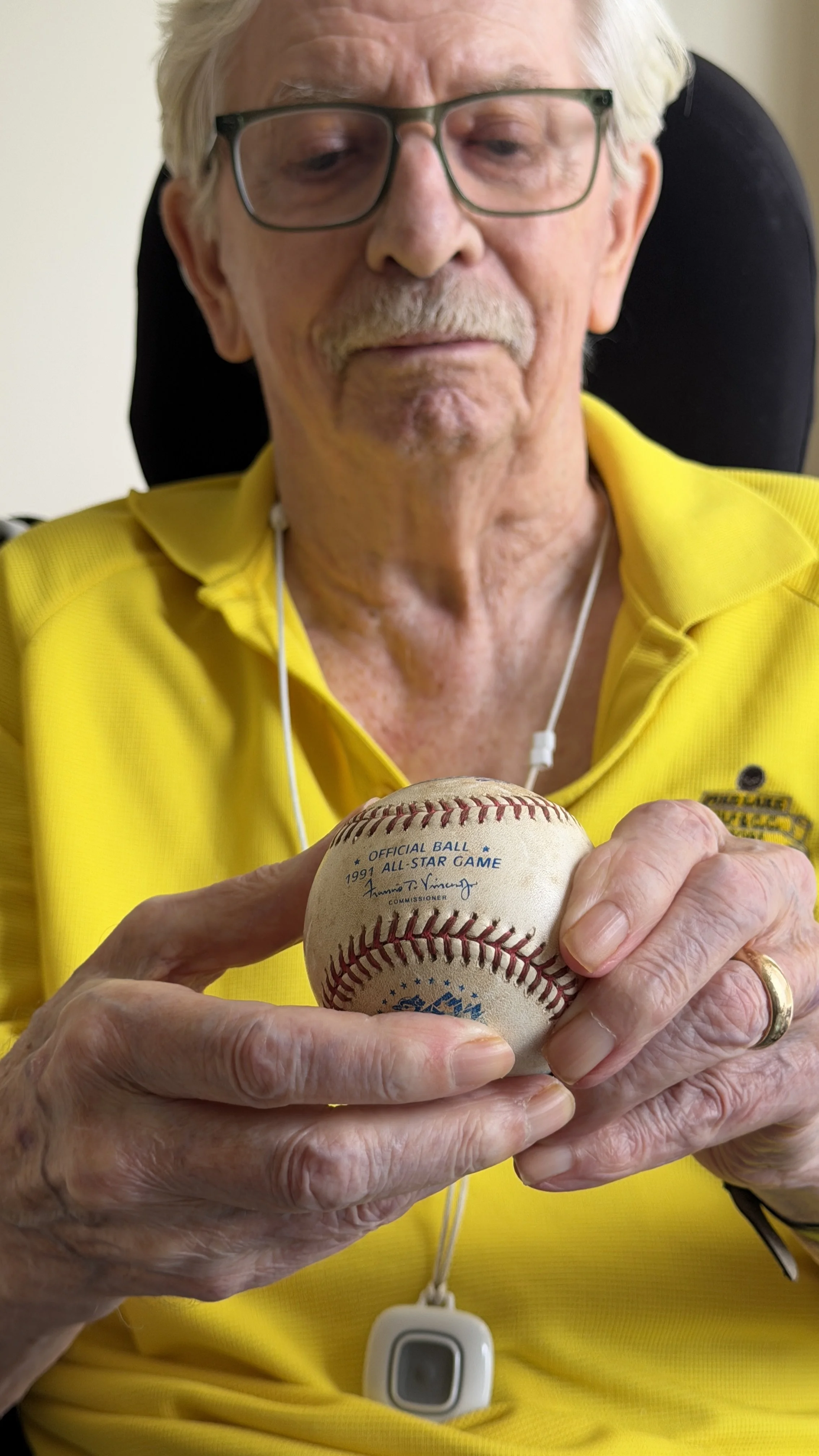
Seven of us, all from Sears, got together and purchased a pair of season tickets during the first twenty years of Blue Jays baseball. Myrwood and I had one of those shares. In 1991, we drew the All-Star Game.
As you might imagine, even sitting in the stands at a baseball game could become competitive between Myrwood and me. Whenever we sat down, one of us would inevitably announce that we had the better seat. Then came the justification. “My seat is better because…” There was always a reason.
At the All-Star Game, I decided to have a little fun with him. A very attractive young woman from the Jays’ Dunedin complex happened to be sitting beside me. We struck up a conversation and chatted throughout the game. I made sure Myrwood noticed. I kept reminding him that while I had someone interesting sitting beside me, all he had was an empty seat. I may have enjoyed that a little too much.
But Myrwood had the last laugh. Because he had that empty seat beside him, he was perfectly positioned when the only fly ball to come anywhere near us in thirty years of attending baseball games together came into the stands. He caught it.
Of course he did. After all my teasing, he ended up with the baseball. On the way out, Myrwood started throwing the ball up and down and said, “Guess who’s the one taking something home now!” That was more than thirty-two years ago.
The ball sat on Myrwood’s dresser. Despite everything he was dealing with, when that story came up, his eyes lit up, and that unmistakable winner’s smile appeared on his face. Some victories never get old.
I am honoured and grateful to his family, who kindly gifted it to me after he passed on as a memento of our friendship.
ChatGPT AI-enhanced image
The Bigfoot Experiment
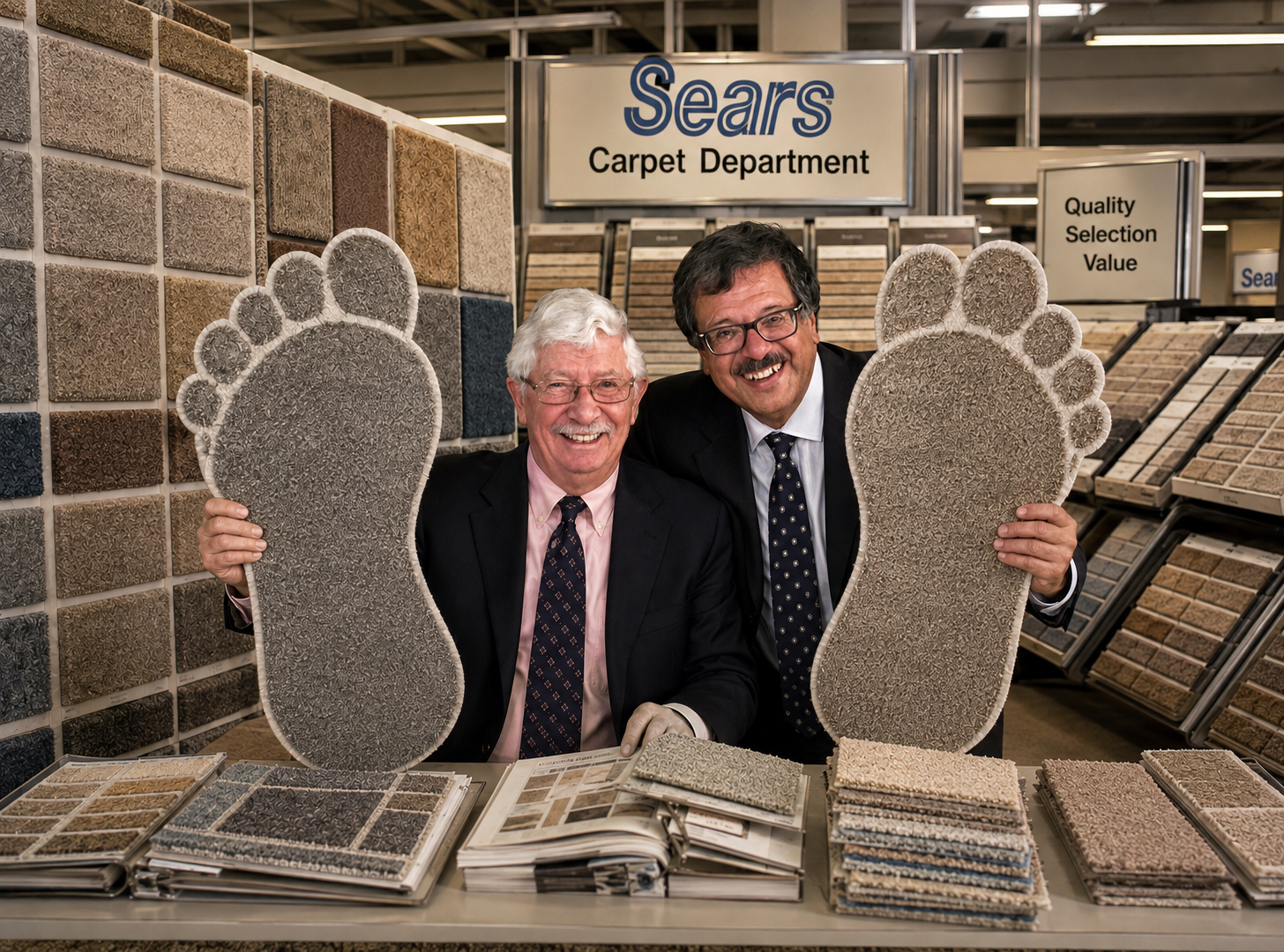
Another episode came about for a completely different reason. We were bored one day. That was enough to get Myrwood and me into trouble—or, more accurately, into another experiment. I took one large carpet sample and cut it into two fairly large pieces. Then I made what could only be described as Bigfoot-sized footprints. We attached an underpad to the bottom of each piece. Then we made a strap that let someone slip their feet into the contraption. The result was ridiculous—and surprisingly effective.
Once you put your feet into the straps and started walking, it felt as though you were walking in snowshoes. You had to walk with your feet spread far apart, and every step felt very different. Naturally, the next step was the fun part. Myrwood and I convinced both staff and customers to put these things on and walk around the department.
Our rationale was actually to have fun; we wanted to convince people that this was a test to experience what it felt like to walk on that particular combination of carpet and underpad. Instead of simply looking at samples, they could actually feel the difference under their feet.
Of course, having people walk around the department wearing homemade carpet snowshoes made it considerably more entertaining.
We had a lot of fun with that one. But, as often happens, word eventually got back to head office. We not only heard about it—we discovered that they thought it was such a good idea that they decided to turn it into a national demonstration.
The concept became a special carpet display in Sears stores across the country. Each display had four windows, allowing customers to see exactly what colour and quality of underpad they were walking on. Our little experiment went from two guys fooling around because they were bored to a national retail demonstration. Once again, Myrwood and I were the talk of the town.
When We Ruled the Carpet Department
Sears provided us with an enormous number of stories, but make no mistake: we worked hard. When Myrwood and I were in the carpet department at Square One, we ruled. Our store was the national prototype, and our salespeople were among the best in the country. One sales contest involved approximately 200 carpet salespeople competing for five prizes across Canada.
From our Square One store, we had three of the five top finishers. Myrwood finished second in the country. Angelo finished third. And I finished fifth.
Three of the top five came from our little corner of the Sears carpet department at Square One. We were proud of that. Perhaps a little too proud.
But then again, we had earned the right to be.
Head office respected us, and buyers listened when we spoke. We had earned a voice—not because we were the most senior people in the room, but because we were close to the customer and seemed to have a good instinct for what they wanted. One sales meeting stands out in particular.
A new line of carpeting was being introduced. It was exclusive to Sears, expected to be an incredible deal, and everyone anticipated huge results. At the time, consumers were highly interested in a clean, crisp blue-grey. The problem was that the new line did not have it. It had what was supposed to be a grey, but to us it looked muddy.
Myrwood and I had developed a keen sense of what customers wanted. In fact, Myrwood had already lost a significant sale because we simply didn’t have the right colour. Emboldened by Myrwood egging me on, I stood up in the middle of the meeting and asked the national buyer why they hadn’t included the clean blue-grey that customers were asking for. He pointed to the grey in the new line and said, “We have a grey right here.” I looked at it and said, “No, that’s a taupe. It’s not the clean grey our customers are asking for.” He challenged me: “Show me.” I said, “Fine.”
I got up and walked out of the training room—in the middle of the meeting. There was a little more at stake here than simply proving a point.
For background, Sears was committing to somewhere between 1,000 and 1,500 rolls of broadloom for the sale. At the time, that was a massive commitment. Typically, an individual colour captured somewhere between seven and ten percent of total sales.
I went down to the floor, found a sample of the grey I knew our customers wanted, and brought it back to the meeting. The reaction was immediate. The others in the room could see the difference. In fact, they commented that the buyer’s original grey looked dirty next to the sample I had brought back. To his credit, the buyer listened.
And the results proved the point. By the end of the sale, our grey had captured 27 percent of the total colour share—roughly three times what we would normally expect.
I remember that moment because it reinforced something Myrwood and I had come to believe: if you listened carefully to customers, you sometimes knew more about what would sell than the people making the decisions from behind a desk.
Square One Style
Many other gang stories come to mind.
There is a game called bullshit poker, where people look at the serial number on paper money and declare poker hands in escalating competition with the opponent. The calculation takes into account the opponent's serial number — which you wouldn't know — and the one in your hand. The premise is that, at some point, the hand declaration sounds off. For example, one would declare two pairs, the opponent would say, "I have three of a kind," and so on.
Remember, our store at Square One was the flagship store, and we were considered the top, biggest, and richest store. Myrwood and I took advantage of that material fact one day when Chuck Frame was just transferred in from another store. We invited Chuck over to play bullshit poker — except this was Square One style. I had slipped Myrwood a fifty-dollar bill earlier (as an aside, I never carried that much cash, let alone two fifties in my wallet).
Then we called Chuck over and asked him if he was interested in a game. When he took out his one-dollar bill and prepared for the game, we asked, "What's that? We don't play with stinking one-dollar bills. We play with fifties. We're big boys here at Square One." Chuck put his bill back in his pocket as we played our fake game. He walked away shaking his head, saying it was too rich for him.
Part Four: Competition
Always competitive.
The Competitive Spirit
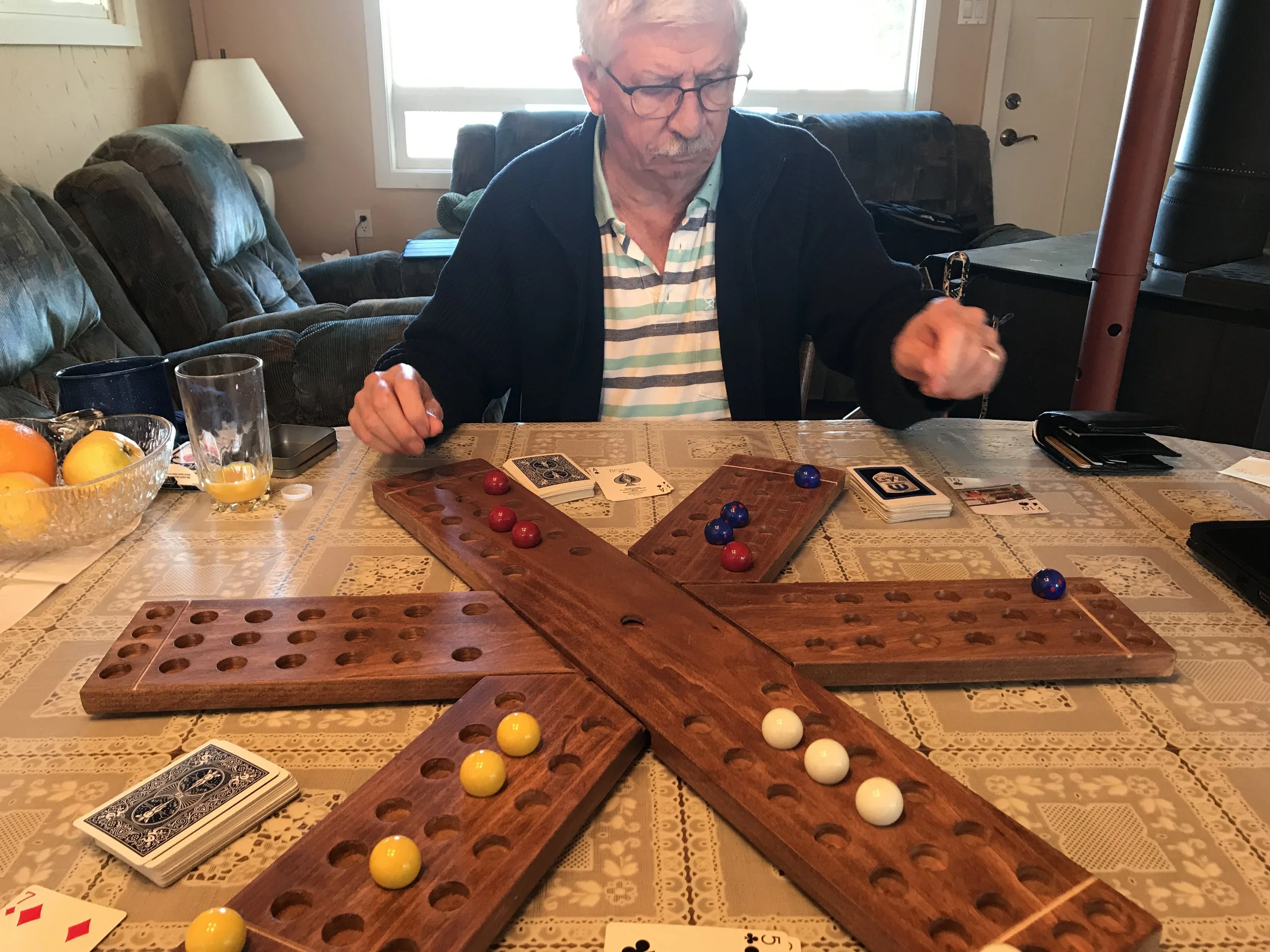
Myrwood and I have always been competitive. But ours was the best kind of competition: serious enough to make it interesting, but never serious enough to matter. We played hard. We played to win. We challenged each other. And, most importantly, we had fun.
Back in the Sears Square One days, our store was the company's national prototype. We were the most successful store, and everyone at head office knew it. Management knew it. Salespeople knew it. And, perhaps most importantly, we knew it.
We had developed something of an ego simply from being part of the store everyone else looked to. Myrwood and I enjoyed playing with that reputation.
We developed a standing joke that we called our “$300 bet.” We would bet $300 on almost anything. Not because we actually intended to collect the money, but because announcing a $300 bet in front of other people was a wonderful way to get a reaction. In all the years we did this, neither of us ever actually made the other pay. One example came after an event near Don Mills and Eglinton. We decided to race back to Square One.
The debate was over which route would be faster: north on the 401 or south along the Gardiner Expressway. Myrwood was convinced the 401 was faster. I was equally convinced the Gardiner was.
Naturally, we declared the standard $300 bet. We announced it loudly enough for everyone around us to hear, just to make it more entertaining. Myrwood took the 401. I took the Gardiner.
I pushed my luck so hard on the Gardiner that I nearly got into two accidents. And after all that? We both pulled into the parking lot outside Sears at exactly the same time. A total dead heat. Neither of us won. Neither of us lost. And, as usual, neither of us paid the other $300.
Whenever we played a game, it was to win, but ultimately, it was just for bragging rights.
Mexican Train
One thing about the gang: we were always very competitive. No matter what, there was always a bet on something somewhere. We never really did pay up, but we always bet. There are a couple of stories about that. Whenever we went anywhere as a group, there was always a game night or a card game on the go.
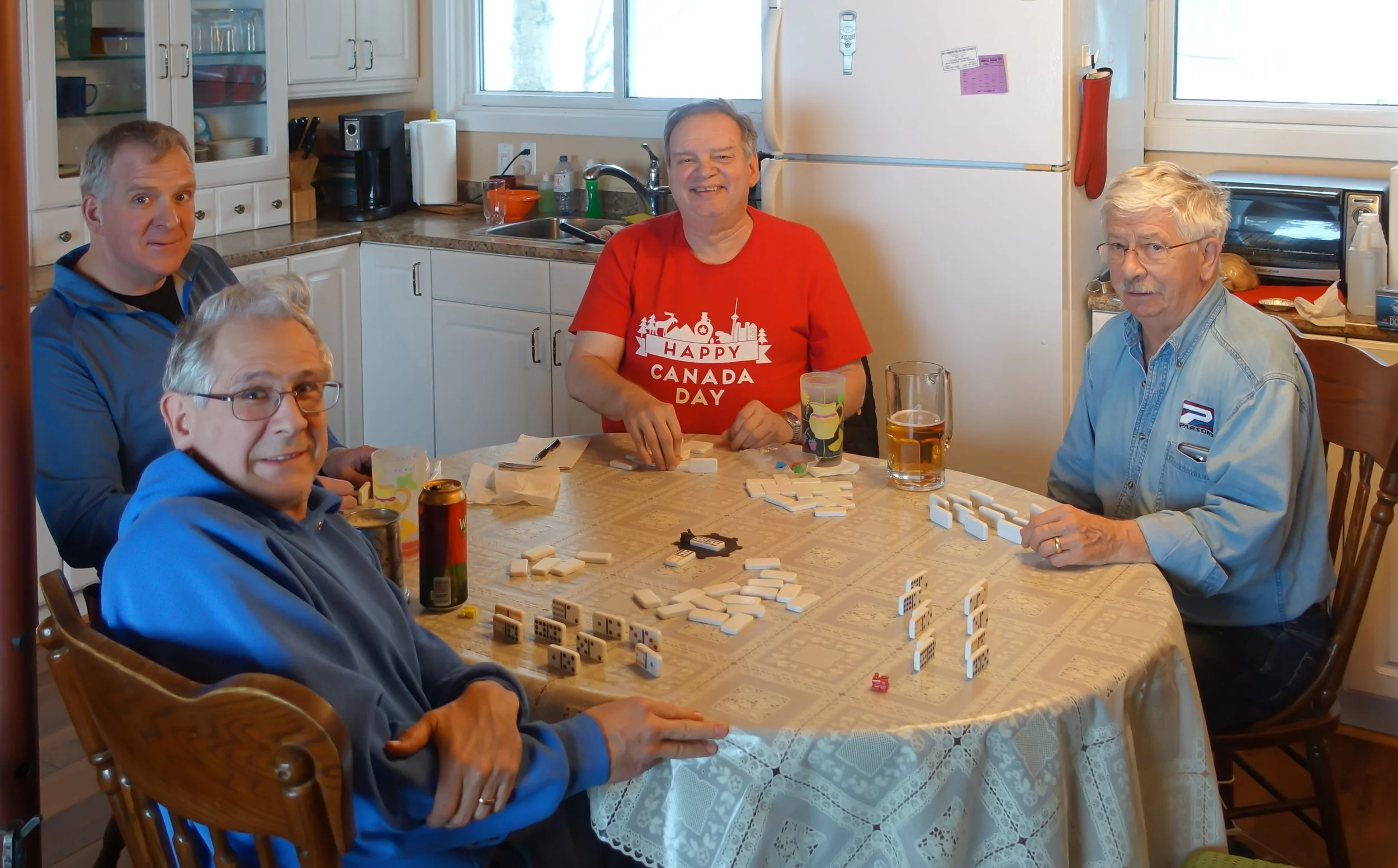
One day, up at the cottage, I was exhausted in the middle of the day, so I went for a nap. But the giggles and laughter outside at the kitchen table sounded like a bunch of 10- and 12-year-old boys having a really good time. Myrwood introduced us to a game called Mexican Train, and the goal is to get on the board and then go around.
The thing was, everybody was so competitive, and we were so evil to each other when we played. It's all for fun, but it's always very cutthroat. So this one time, in a game of Mexican Train, Bob May couldn't get on the board, and the laughter every time someone had a chance to help him and didn't was hilarious. Here I was, lying on my bed trying to nap, and here were these guys, literally like a bunch of 10-year-olds having the time of their lives. Even though I was not even playing, it was memorable. But isn’t that what a rich life is about?
It was so much fun to be on the outside hearing the joy and evil laughter in the other room. And the thing is, those games weren't remembered for a little while, but for a long, long time.
Extreme Canasta
We were very competitive — I've mentioned that before — and it wasn't just Myrwood and me. Our whole group of guys were. We had euchre tournaments, but it wasn't just at tournaments. Any time we played anything, it was take-no-prisoners. Bragging rights didn't fade quickly; often, games were talked about for decades.
One such game — I think the precursor to the high-stakes, aggressive nature of the games — happened when we were in Kananaskis country, at the edge of the Rockies, one hour west of Calgary. Just the two of us, playing canasta.
Before I talk about what we did, you need to know one element of the game. There's a distinct advantage to picking up the discard pile in the middle.
Neither of us was going to let the other pick up the pile of cards and win the hand. To stop that, we could increase two things: the ultimate reward and the duration the pile couldn't be picked up—and we could do that by playing wild cards on top of the pile.
We ended up using both decks, with all the wild cards in the pile. Neither one of us could pick up the pile, and we had a draw.
From then on, the game name changed to extreme canasta — or extreme euchre, or extreme whatever.
The Gentle Soul and the Euchre Tournament
Myrwood also had a gentle, thoughtful side that was evident, especially compared with his competitive nature.
One example came when he and I attended a euchre tournament in Barrie organized by his brother’s service club. I thought it was a terrific fundraiser idea.
I eventually brought the idea back to the Scouts.
Thanks to Myrwood introducing me to the concept, we started our own euchre tournament to raise money for the Scouts Canada camp fund. Over the years, that simple idea has raised more than $130,000 for Scouts Canada. I am no longer involved in the planning, but Phil Chiasson and his group picked up the concept and improved on it. In fact, we shared the rules and scoring cards with several other groups wishing to replicate our success story.
But another Myrwood story is attached to those tournaments.
The 3100 Club
Myrwood and Cynthia would arrive with what could only be described as a busload of octogenarians from their condominium—the euchre players from the 3100 Club.
These were serious euchre players.
Very serious.
Ironically, somehow, Myrwood, the gentlest of souls, managed to intimidate my neighbour, Susan.
Our tournament format had four players at each table: two visitors and two home-team members. As the rounds progressed, the visitors moved up to the next table. The visitors at Table Three would move to Table Four, and so on. Susan was a visitor and would move up between rounds; she was relieved to see that Myrwood and his partner were a home team and were sitting just one table below her. That meant, under the normal rules, she would be moving farther away from them. Unfortunately for Susan, she told me about her fear.
She looked at me and said how happy she was that Myrwood would be farther away. Well, that simply presented an opportunity. As tournament organizer, I felt it was my responsibility to address this obvious flaw in the system.
So, we announced a rule change. That year, the visitors would move down instead of up. Myrwood and Susan met in the second round. But something wonderful happened. Once Susan got to know the real Myrwood, the intimidation disappeared. By the end of the evening, the two had become great friends.
Sometimes the best way to overcome intimidation is simply to sit down at the same table.
Taking No Prisoners
This is one of the taking-no-prisoners stories. We would go as a group over to Lewiston, New York, and have lunch at this famous place — a Sunday brunch. One time, Angelo was in one car, and I was in another with Myrwood in the seat behind me with his date. Donna was beside me at the front.
On the way back, we raced to get to the customs booth, with Angelo ending up behind me. We were stopped at the border crossing. The woman in the booth dropped her pencil and laughed at something, so I thought she was human — and with Myrwood egging me on, I told her, "You know, the guy in the car behind us is with us. You should search him." She said, "Just move on."
Angelo drove forward to the kiosk. It was obvious he and the border guard were talking. Then, all of a sudden, Angelo got out of the car, opened his trunk, took out his leather jacket, and became really animated. Eventually, Angelo started jumping up and down. We couldn't figure out what happened until he threw his coat back in the trunk, slammed the lid down, drove up to us, and said, "Someday, Kerba, I don’t know how or when, but I'm going to get effing even with you guys."
So this is how the conversation went between him and her:
"Hi, how are you?"
"I'm fine."
"Where were you?"
"We were in Lewiston."
"What were you doing in Lewiston?"
"I was having lunch with my friends."
"Did you buy anything when you were there?"
"No, I didn't."
"Can you open your trunk?"
He gets out of the car and opens his trunk.
"What's this?"
"It's my leather coat."
"Why is it in the trunk?"
"It was too hot to go into the restaurant with it, and as a result, I left it in the trunk. I didn't want it to get stolen."
"It looks new to me. Do you have a receipt for it?"
"What do you mean? It's an old coat."
“It looks new. Where is your receipt?”
Angelo became agitated and started jumping up and down. He said, "It's an old coat — who carries a receipt for an old coat?"
"Oh, just put it back — your friends set you up. Have a nice day."
That was at least forty years ago. We wouldn't be doing that now while crossing the border.
Part Five: The Road Trips
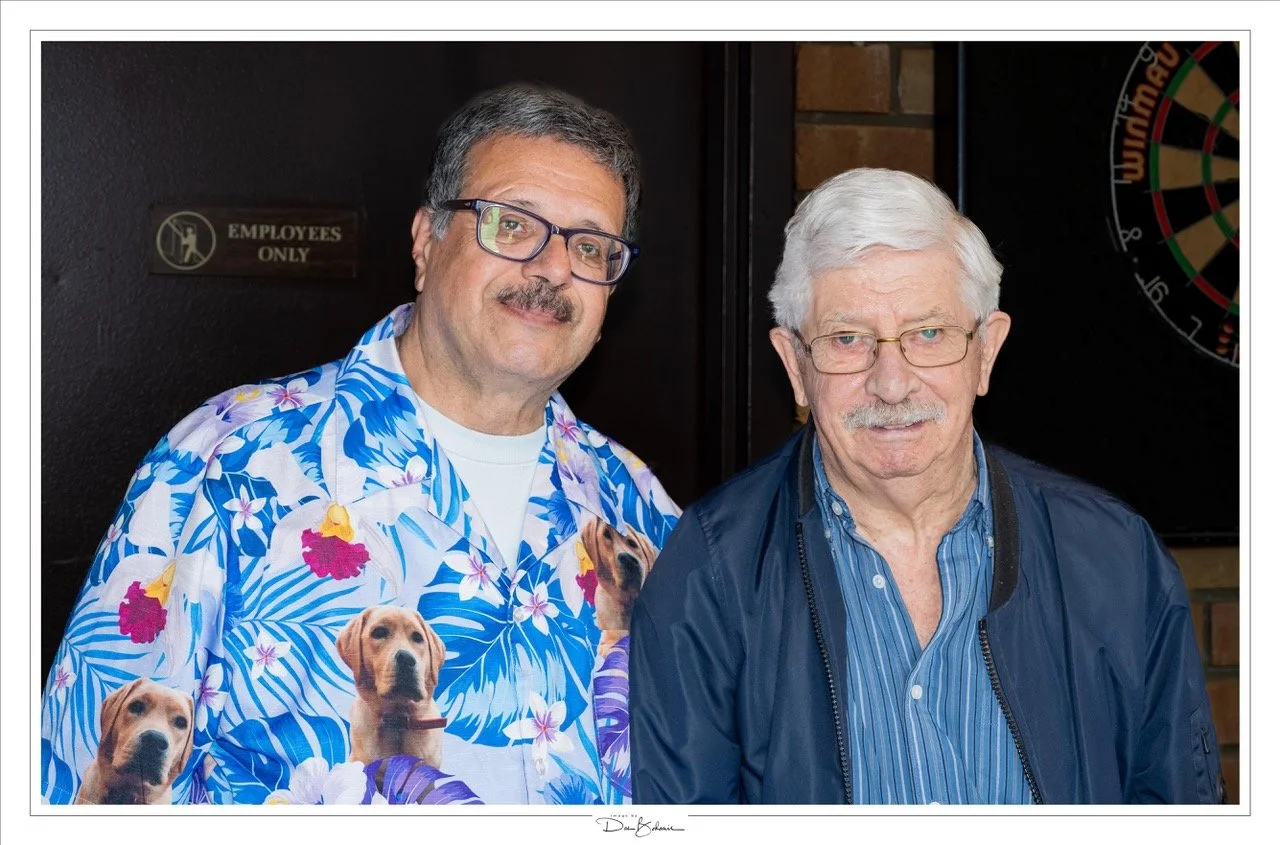
Photo Credit: Dan Bodanis
The Boys’ Road Trips - Permissions from Wives
We had legendary road trips. Over time, they went from day-long ice fishing trips to weekend-long cottage trips, and then the trips got more and more ambitious. It didn't matter who was on the trip — it always felt comfortable. We never had words, and everyone was always welcome on the next trip.
One such trip was hatched over lunch with our mutual friend Bob May. We would be going to see the Toronto Blue Jays at spring training in Dunedin, Florida. That lunch was in Wasaga Beach. It took less than an hour to call up the candidates as potential travel companions — by the time I got home, we had a group of six.
My favourite acceptance phone call wasn't the interaction with any of the guys; they were an automatic yes. It was the wives I needed to approve the guys going.
Cynthia answered the phone. After a brief hello and a mini chit-chat, I figured I would break the ice for him, not that he needed it. I put it to Cynthia this way: "How would you like to get rid of your husband for twelve days? I have something up my sleeve."
This is my favourite quote in this article: She said, "Here he is." As she was handing Myrwood the phone, I could hear her tell him, "I don't know what he wants, just say yes." I spoke with some of the other wives and told them there would be no babysitting fees; others I told there would be babysitting fees. I'm not sharing who I told what.
Rules of the Road - “Epic and Slow”
Every road trip had conditions and stipulations. We refined these over a half dozen major boys’ road trips, no matter who was on the trip. I'm sharing them here because Myrwood and I pretty much refined them. This wasn't a race; it wasn't about the destination; it was about the journey.
Six hours maximum car time per day. No one would drive more than two hours at a time. Every day, we had to see something special. We stopped for lunch and arrived at our destination in time for check-in, dinner, and a card game if needed. We would stop anytime for a bathroom break if needed - all one had to do was give the driver advance notice. We shared the gas, and at meals it was separate tabs. We split any event or entrance fees, or paid separately.
The Florida trip, for example, was just over 4,500 kilometres. Over time, a simple average including all stops was 90 km per hour of travel. This average included bathroom breaks, lunches, and gas stops. So the Florida trip was going to be fifty hours of driving. With a maximum of six hours a day, that meant eight nights on the road. We went through eleven states and eight places to see—and not just drive through. We saw and did some amazing things.
One memorable stop was at the World Golf Hall of Fame. At the time, it was located in St. Augustine, Florida. That's where we had the epic mini golf tournament, which Myrwood won, of course. Then we went to the Castillo de San Marcos, where I made the guys pose inside cannons. It was amazing what I could get guys to do for the camera. On that trip we also visited Macon, Georgia, known as the cherry blossom capital of the world. It is famous for having over 350,000 cherry trees - that's 90 times what is around the Tidal Basin in Washington, DC. In Washington, we split up based on which museum people wanted to go to.
One funny thing on the trip to Florida: it was so long ago that phones were expensive to use, and not everyone had a cell phone. I set up my computer, and we made calls over the internet. The thing was, we each dutifully called our wives to report that we'd arrived safe and sound. The really funny part was that it felt like a competition among the wives to see who could get back to her show faster, or whatever she was doing before the phone call interrupted her. One unnamed fellow traveller was literally told she had to go back to her game show on TV, which he had interrupted.
In addition, we had extra days in Florida to take in a couple of spring training games. The beauty of this was that, when we were in Florida, we didn't even have to do the same thing. One day some guys went to the East Coast, and others rented a car to go to the West Coast. It didn't matter which two or three it was, or that four would go one way and two the other. It was comfortable to be who you were with.
Rumble Strip
Highway construction accounts for people straying out of their lanes. To wake the driver up or alert them, highways have rumble strips: crossing that ribbed line creates a jerky ride, a warning to get back on the road.
On one trip to Calgary for a conference, I really wanted to see the mountains, so I invited Myrwood to join me. We spent three days in Calgary, then rented a car and went into the mountains for five. We were supposed to take turns driving so no one got too tired. The problem was me: I'm too distracted by the beautiful scenery and mountains, constantly looking for the next picture. When Myrwood drove, as one of a trusted handful of chauffeurs often will do for me, he would stop on command for that picture. I have my people.
Myrwood was very accommodating with these stops. But I also wanted to help drive, so I still took my turn at the wheel.
Unfortunately, that didn't stop me from gawking at the scenery, which in turn sent me over the rumble strips. And every time I went over, Myrwood would press his imaginary brakes and hold onto the dash. So we instituted a three-times-and-out penalty: if I went over the strips three times during my turn at the wheel, he would take over.
It didn't take him long to realize that while I didn't do it intentionally, my turns behind the wheel were shortened, which in turn gave me more photo opportunities. In time, we both came to think that I went over those strips on purpose, just to have more time to gawk. He must have driven 35 of the 40 hours of that trip.
I will never admit whether that was by design or accidental.
Sleeping at the Cottage
Best pals will do almost anything to make sure we can be together. For two guys, sleeping in the same bed is still awkward. Myrwood and I had to share a bed on occasion.
On the BVI sailing trip, we were bunkmates. On that one, no offence to Myrwood, after two nights it was the tight quarters that did me in. I discovered sleeping under the stars was such an awesome experience.
Then, on a baseball boys’ trip, we found a hotel with two double beds across the street from Fenway Park.
The most memorable one, though, was the boys' winter cottage weekend. We had to share a bed again, under an electric blanket. At breakfast, I complained that I was hot all night. “Funny thing,” Myrwood replied, “I was cold all night.” He then said, “All night long I kept getting colder and colder. I kept increasing the blanket temperature, and it never warmed up! It didn't feel like the control was generating extra heat.” We discovered that the electric blanket switches were on the wrong sides.
In reality, Myrwood raised the heat on my side, and I lowered the temperature on his. He kept lowering my side while I raised his.
The Case of the Forgotten Keys
Myrwood had a fairly substantial keychain back then. It contained keys for all sorts of places and things, including the lock on his luggage. In the excitement of arriving at Buffalo airport and getting ready for our trip, Myrwood decided he didn’t need to carry that bulky keychain. Instead, he took a secondary keychain containing only the key to his car. A perfectly reasonable decision.
Until we arrived in St. Thomas.
At the airport, customs officers randomly selected Myrwood’s locked suitcase for inspection. It quickly became apparent that Myrwood and the customs officer were having a rather animated discussion. Myrwood eventually announced the problem.
“I forgot my keys back in Buffalo.” The officer did not find this nearly as amusing as we did.
He told Myrwood that he had to open the suitcase. “I wish I could, Officer.”
The officer then asked whether he had a knife he could use to open it. Myrwood found this particularly amusing. Asking a passenger if he had a knife on an airplane seemed like an odd line of questioning. He didn’t have one.
The officer persisted, asking to see the contents. Myrwood persisted in saying he wished he could. Neither side was getting anywhere.
Eventually, security determined that they didn’t have anything available that could unlock—or break—the tiny luggage lock. So they let him go.
The problem was finally resolved at the hotel, where the little lock was clipped off in about two minutes. That was the end of that lock. Now, 40 years later, it is still funny.






The Two-Minute Customs Office
That wasn’t Myrwood’s last encounter with customs.
While we were in Jost Van Dyke, we came across a fascinating little customs operation. The building housed two offices side by side—one for the British Virgin Islands and one for the United States, for people travelling onward to the U.S. Virgin Islands.
Essentially, it was one long counter divided by a panel. One side was BVI. The other was USA. Myrwood needed a stamp on his passport from the U.S. side.
He walked into the office, where the agent sitting at the BVI side told him to come back after 11:00 a.m. It was 10:00 a.m. Myrwood accepted this and went on his way.
About forty minutes later, he apparently thought there was no harm in checking whether they might have opened early. It hadn’t. The same agent behind the BVI desk became impatient and reminded him that the office was closed because it wasn’t 11:00 yet.
At precisely 11:00, Myrwood returned. The same fellow sitting at the BVI desk simply stood up, walked about five feet to the other side of the counter, and announced that the American counter was now open. That was it. No great bureaucratic process. Just five feet.
Myrwood shook his head over that one for the rest of the trip.
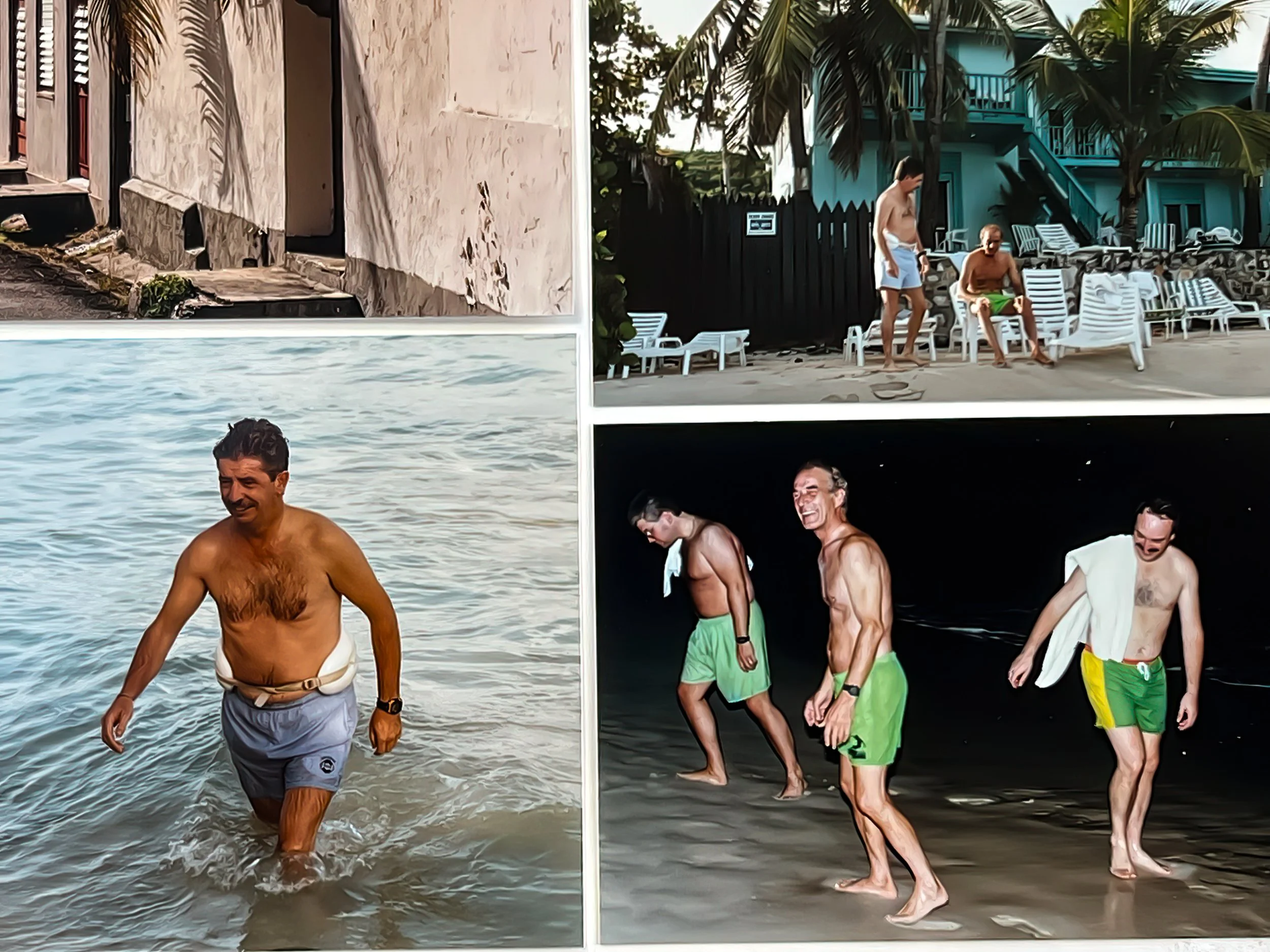
From the Big Ticket Cruisers Archives
Nothing Was Going to Stop Myrwood
Another side of Myrwood became very apparent during that trip.
He couldn’t swim. In fact, being in water over his head was something he genuinely feared.
So, we bought him a flotation belt.
By the end of the trip, this same man who had been afraid of being out of his depth was swimming circles around the boat in forty feet of water.
Nothing would stop him from participating.
Once Myrwood decided to do something, he found a way.
That determination was one of the qualities I admired most about him.
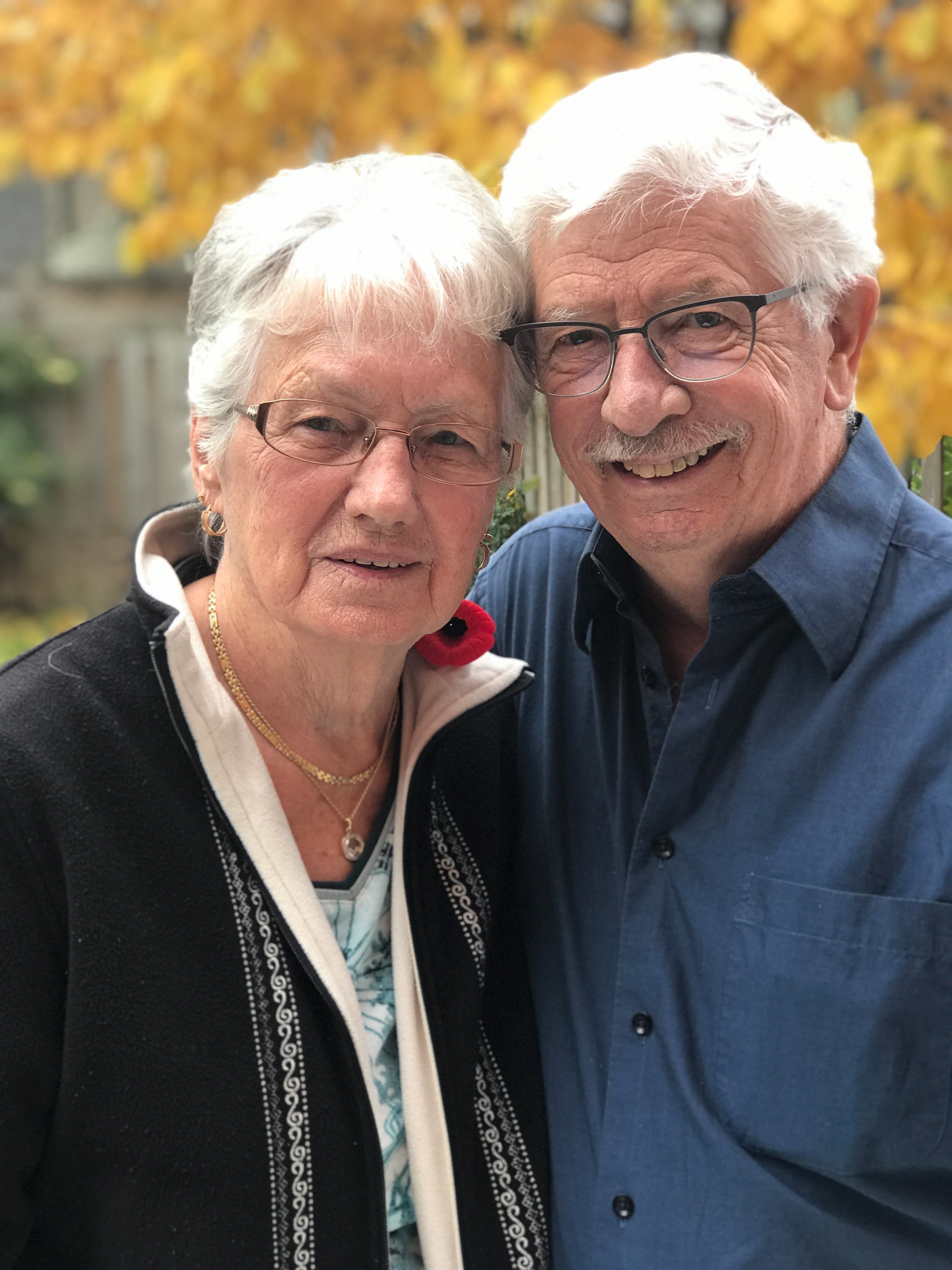
Myrwood and Cynthia
A Final Thought
Before I close this, I need to say something about the last five years — because the stories I have told you are the Myrwood of the good years, and that is not the whole of his journey.
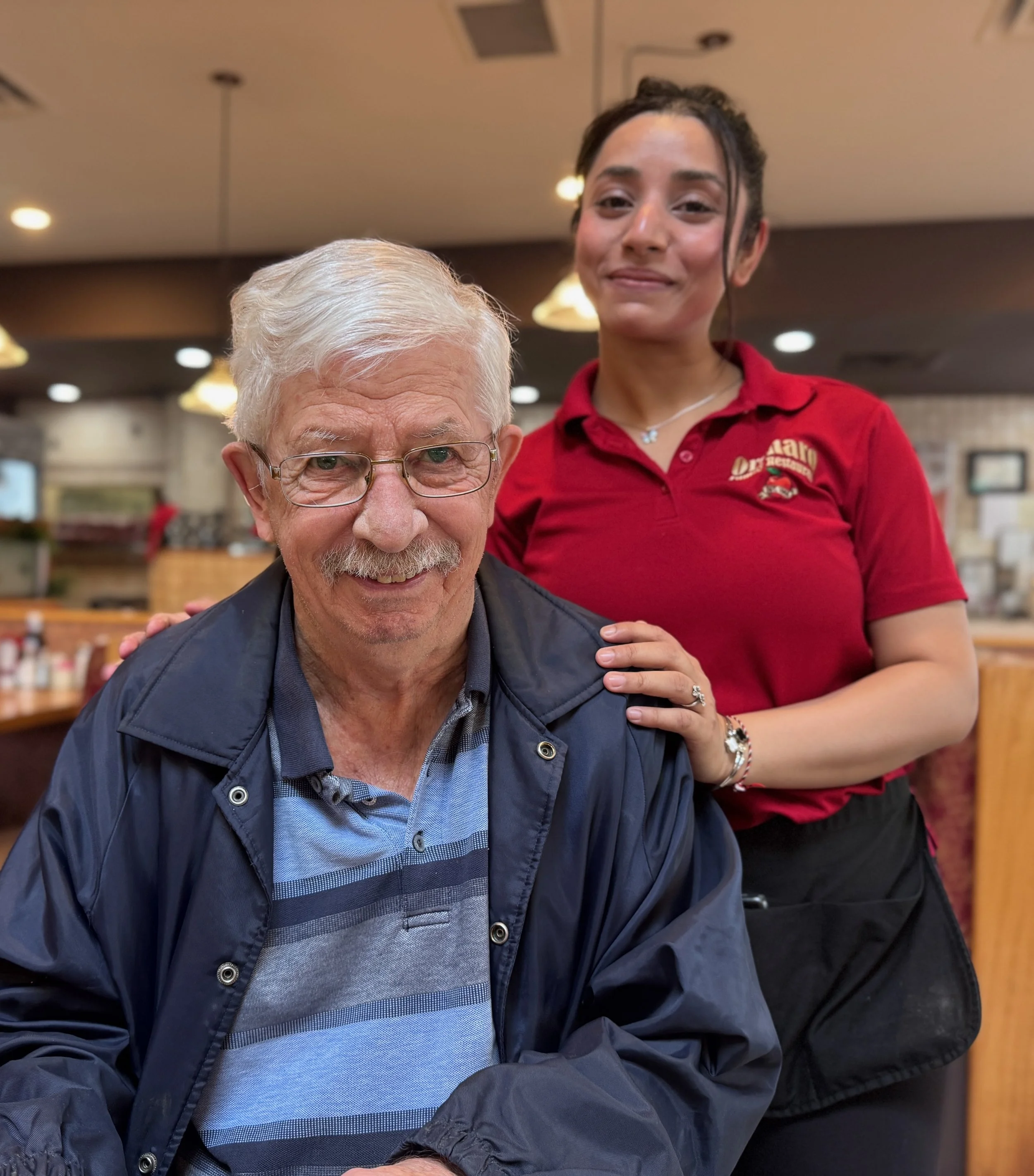
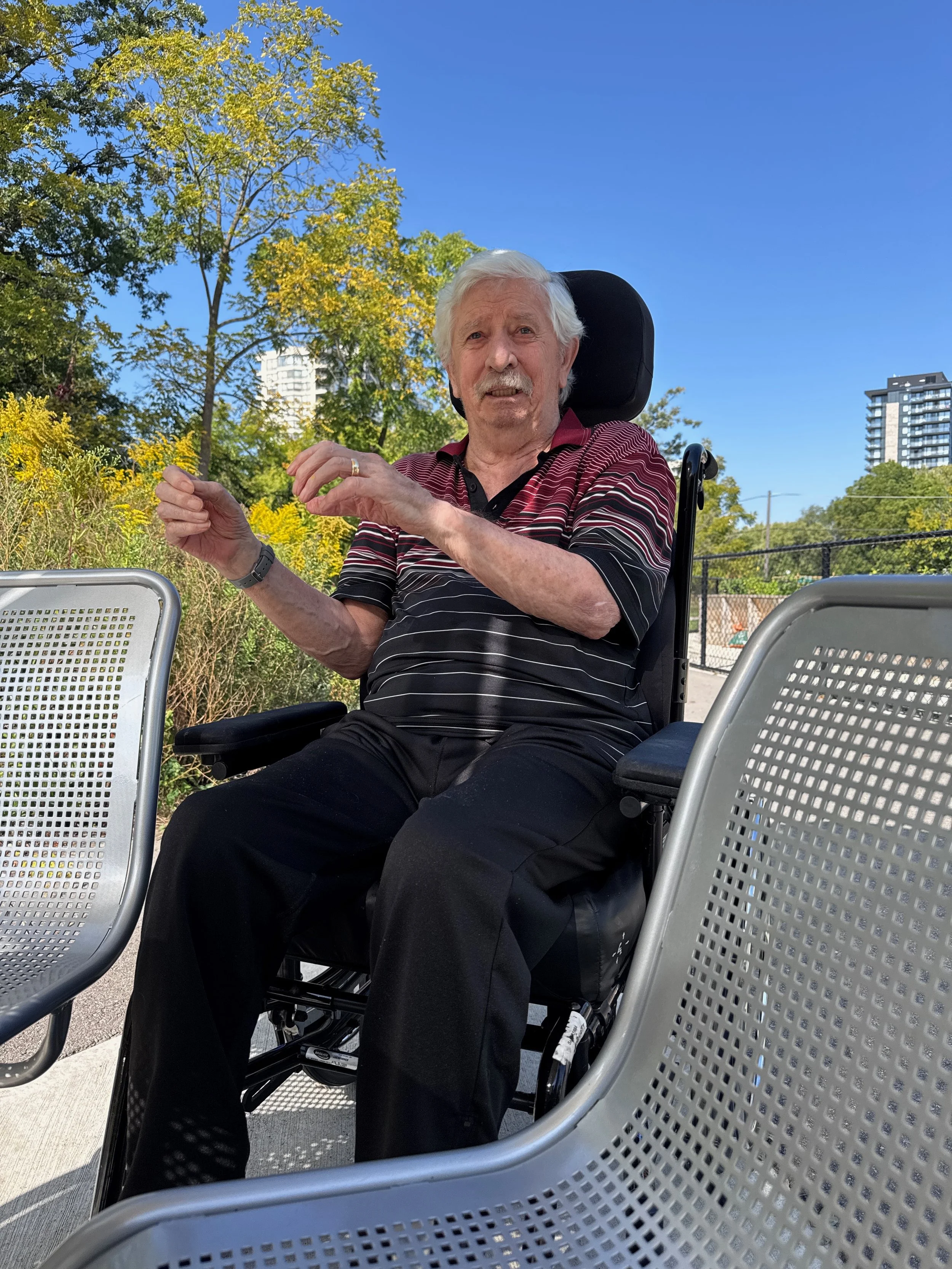
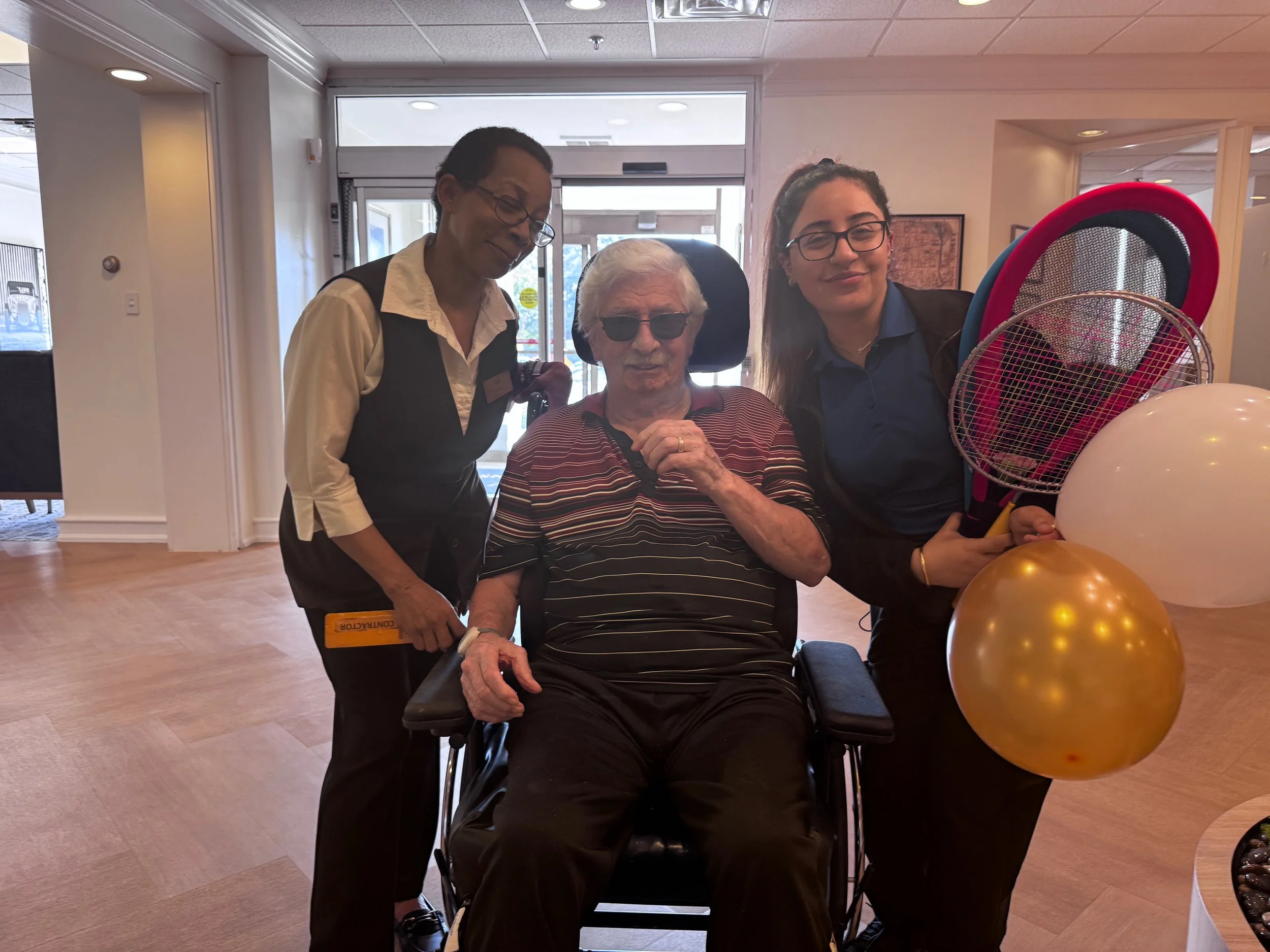
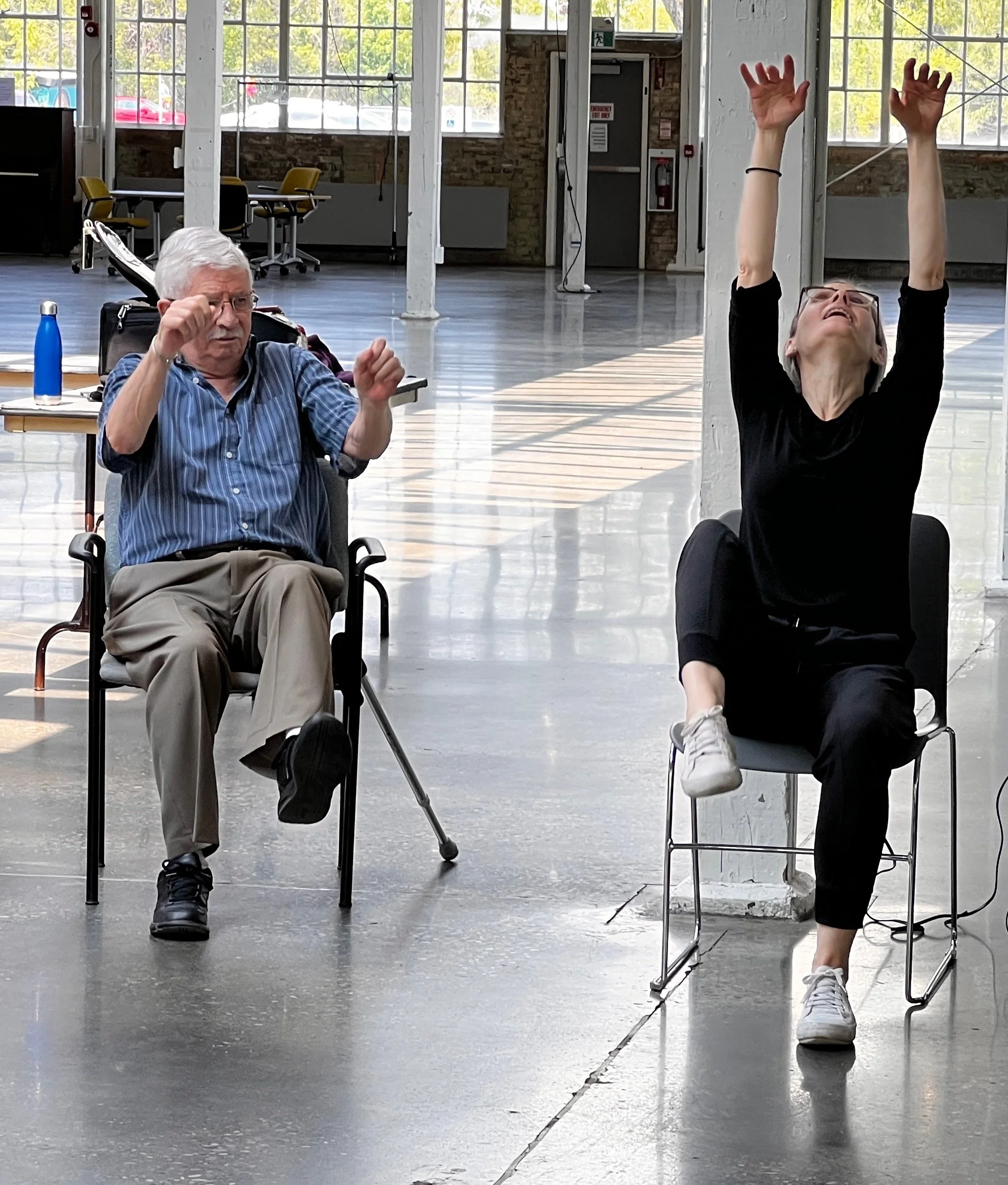
Cynthia was by his side through it all. Through the five long years of that agonizing journey with Parkinson's, she was always there, by his bedside, living with the ever-deteriorating conditions day after day. I was a mere spectator. I visited every other week when I could, and I took him on walks around the block now and then—but those were an hour here and there. I knew what was happening, but I was only an observer. Cynthia lived it.
I knew what to look for, because I had seen it before. My father went through his own trials and tribulations with the disease, and Myrwood mirrored those ever-worsening conditions. I watched the same slow decline a second time, and I knew where it was headed.
My uncle told me many years ago that it is one thing to have an illness where, with surgery or medication or just time, you will get better — and a totally different thing to have something that gets worse every day. Even when the change is imperceptible, it affects the psyche differently.
Myrwood, just like my dad, handled it with grace and elegance — at least on the days I visited. Kudos to David and the family as well, who stepped in when they were needed and moved him to Georgetown in the final part of the journey. When Myrwood could no longer stay in Mississauga.
That, too, was Myrwood. And that, too, is part of the friendship.

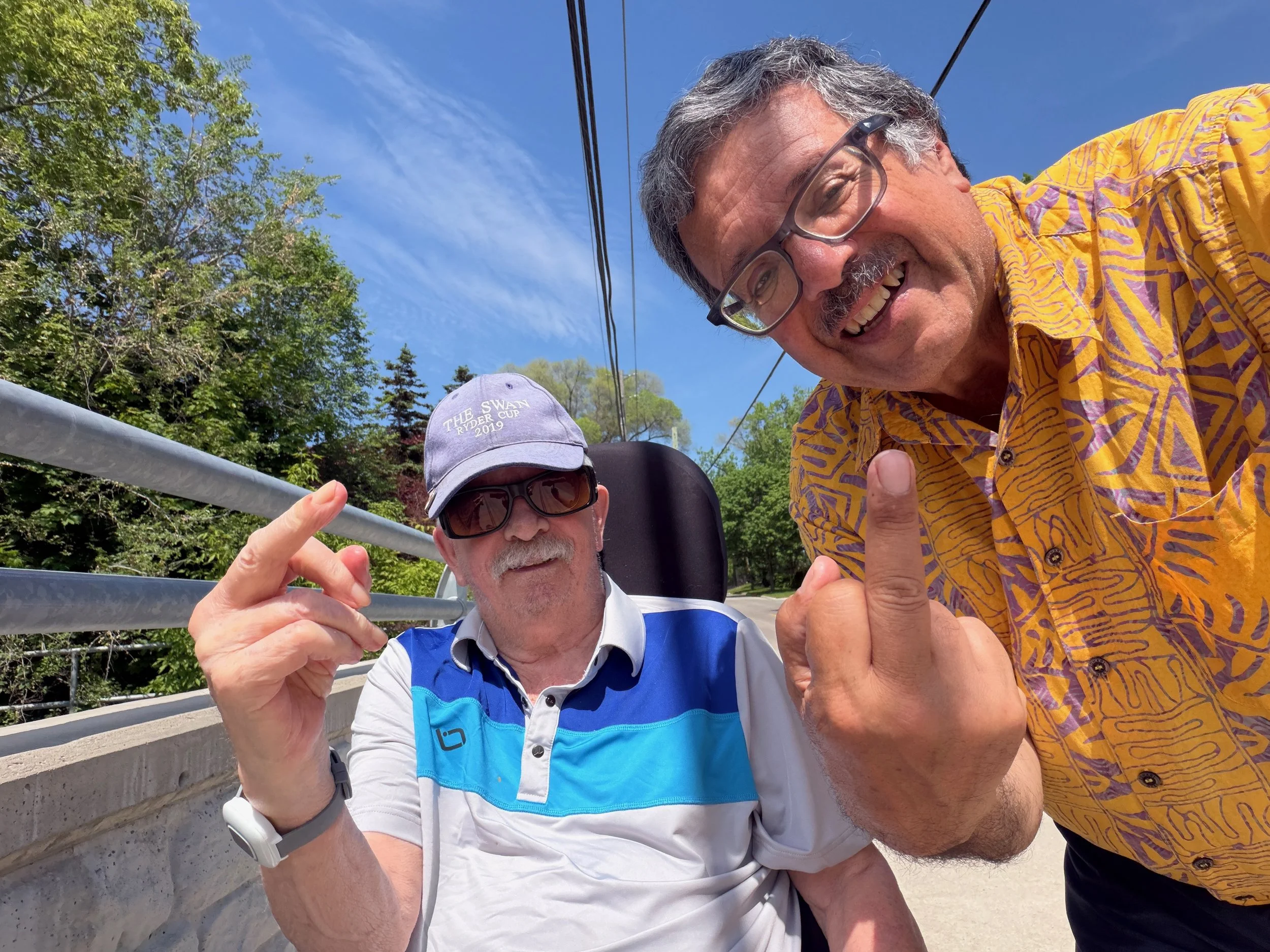
Our message to Parkinson’s